About · Aymane Hitmi
I used to run a team of 12 developers. Now I run a team of AIs, and I still make every call.
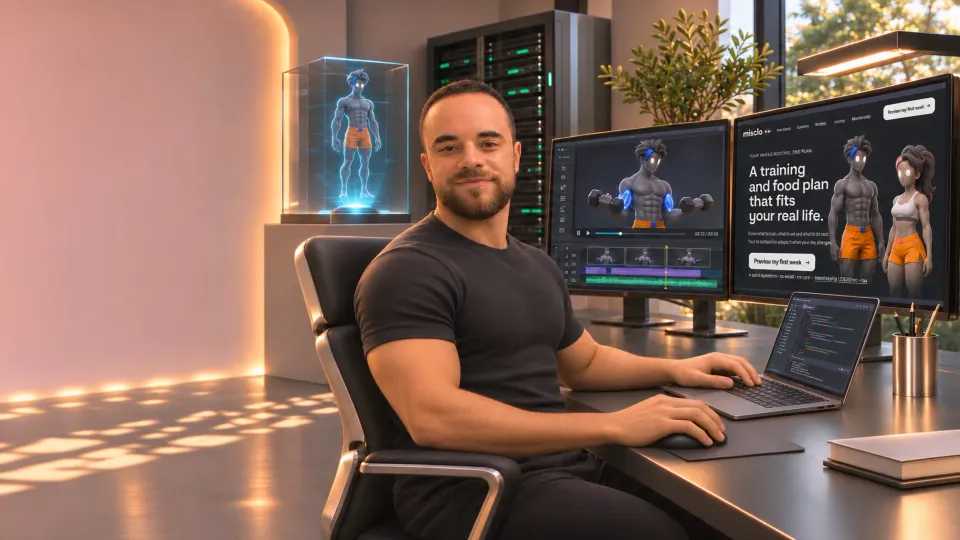
I’m Aymane Hitmi. I’m Moroccan, I live in Bali, and I’ve managed 45+ digital projects. I was CTO of a US marketing agency. Today I build alone, with AI doing the work a team used to do, and I do it in public so you can see the method before you trust it.
This page is the long version: where I come from, how I work, what I won’t do, and how I’ll use an AI version of me on Instagram, labelled every time.
The record, in four numbers.
Career and agency numbers, built with human teams. The AI chapter is below, shown as work in progress.
- 45+digital projects managed, across my whole career.
- 12developers in the international team I led as CTO.
- 28+client platforms my team delivered and maintained during my agency years.
- 2software products I built and shipped myself.
Chapter 1The start
I started young, and I started by building.
After that I freelanced, building websites and platforms for clients. Freelancing teaches you one thing fast: nobody cares how clever the code is if the project doesn’t land. You write the brief, you set the scope, you ship, and you answer the phone when it breaks.
Chapter 2CTO
Then I became CTO of a US marketing agency.
For more than four years I was CTO of a US marketing agency, leading an international team of 12 developers. With that team I delivered and maintained 28+ client platforms, among them learning platforms, membership communities and private intranets.
That job taught me what AI still can’t decide for you.
- Which problem is worth solving first.
- How data should be structured so the platform survives its second year.
- Where a permission bug will hurt real people.
- How to say no to a feature that would sink the deadline.
AI makes the build faster. It doesn’t make the architecture decisions.
Chapter 3The hard kind
Most of my career has been the same kind of hard problem: many people, one system.
The projects I’m proudest of aren’t the prettiest. They’re the ones where the real world refused to fit a template, and the structure had to be designed before a single page was built.
- tenants → cohorts
Learning platform
A multi-school learning platform in three languages.
Many schools, gamified learning, one platform. The hard part was the tenant and cohort model, not the lessons.
- course → test → certificate → purchase
Certification
A certification journey.
Course, assessment, certificate and purchase joined into one path, so a learner never falls between four tools.
- household → members
Membership
A family-account membership for a nonprofit.
Real families don’t fit “one user, one login”, so the account model had to start from the household.
- intranet → academy
Intranet
A private intranet and training academy.
One place for a team’s internal communication and its training path.
- plugin → site
My own products
Two products of my own.
I built and shipped two commercial WordPress products.
Client names stay off this page until each client agrees in writing. I describe the problem I solved, never their results.
Chapter 4The turn
The team I used to lead is now a set of AI lanes. The judgment didn’t move.
When AI tools got good enough to write real code, design real interfaces and produce real media, I didn’t see a shortcut. I saw the agency I already knew how to run, reorganised. A strategist, a designer, a front-end developer, a QA lead, a media team: each one is now an AI lane with a written brief, and I sit where I always sat, deciding what gets built and approving what ships.
I want to be precise about one thing. My 45+ projects were built with people. Working solo with AI is the new chapter, and I’m showing it in public while it happens, mistakes included.
Chapter 5Now
My own product is the test bench. You can watch it being built.
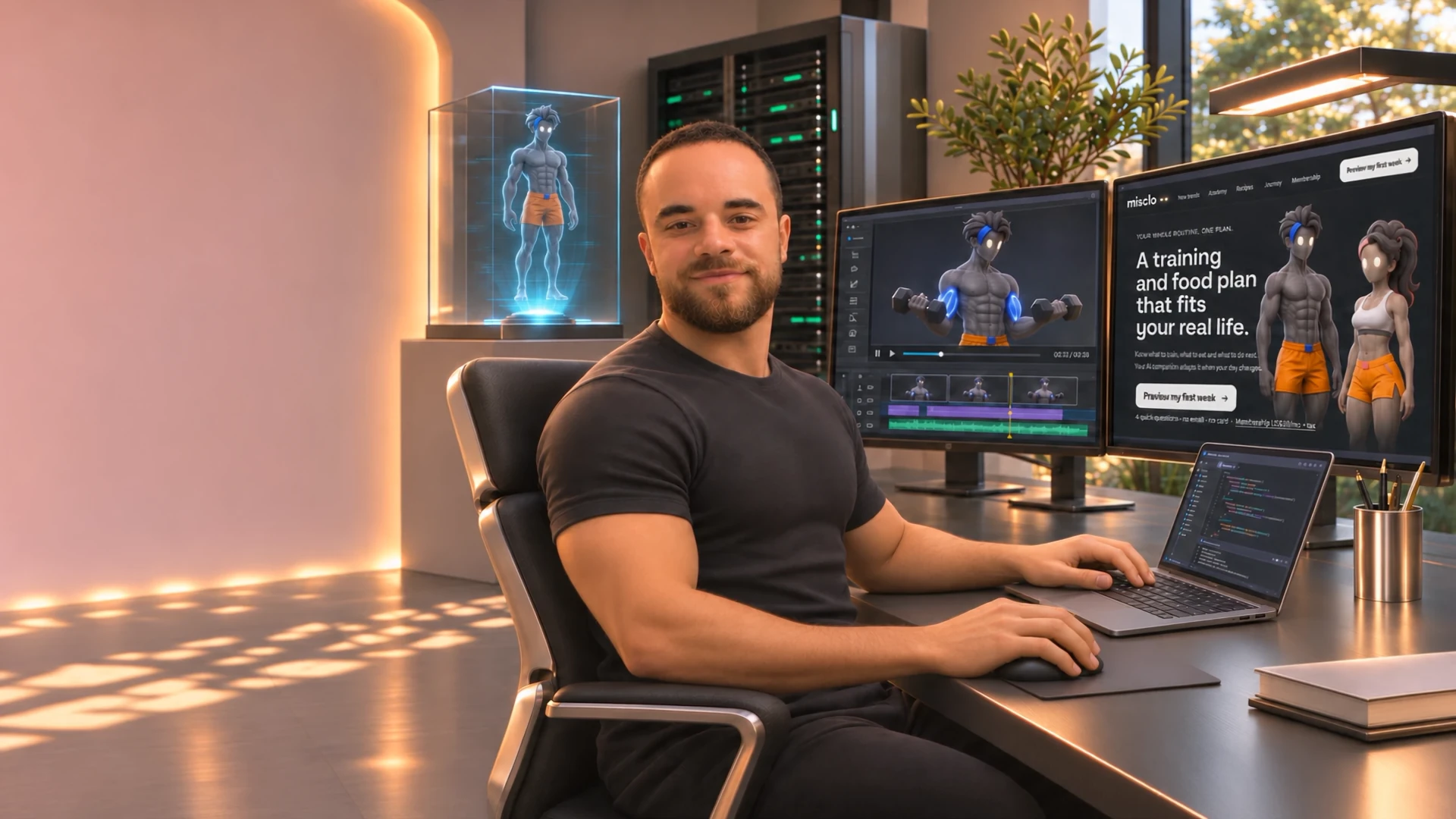
Right now I’m building Misclo, my own fitness and food app. It’s in development, set to launch on 1 January 2027, and it’s where I prove the method before I teach it or sell it. So far that’s an immersive marketing site in staging, a WebGL 3D body map in man and woman views, with 228 muscles and bones in 21 muscle groups (the anatomy model is by Alex Lashko), and a 3D trainer character called Theo.
Theo started as a Tripo AI mesh. I rigged and animated it in Blender with tools that AI wrote for me, and every change is measured against reference art instead of eyeballed. The same lab produced one finished 17.6-second reel through a research, render, voice and compose pipeline.
None of it has users or results yet, and I won’t pretend otherwise. It’s proof of what one person can build with an AI team, not proof of sales.
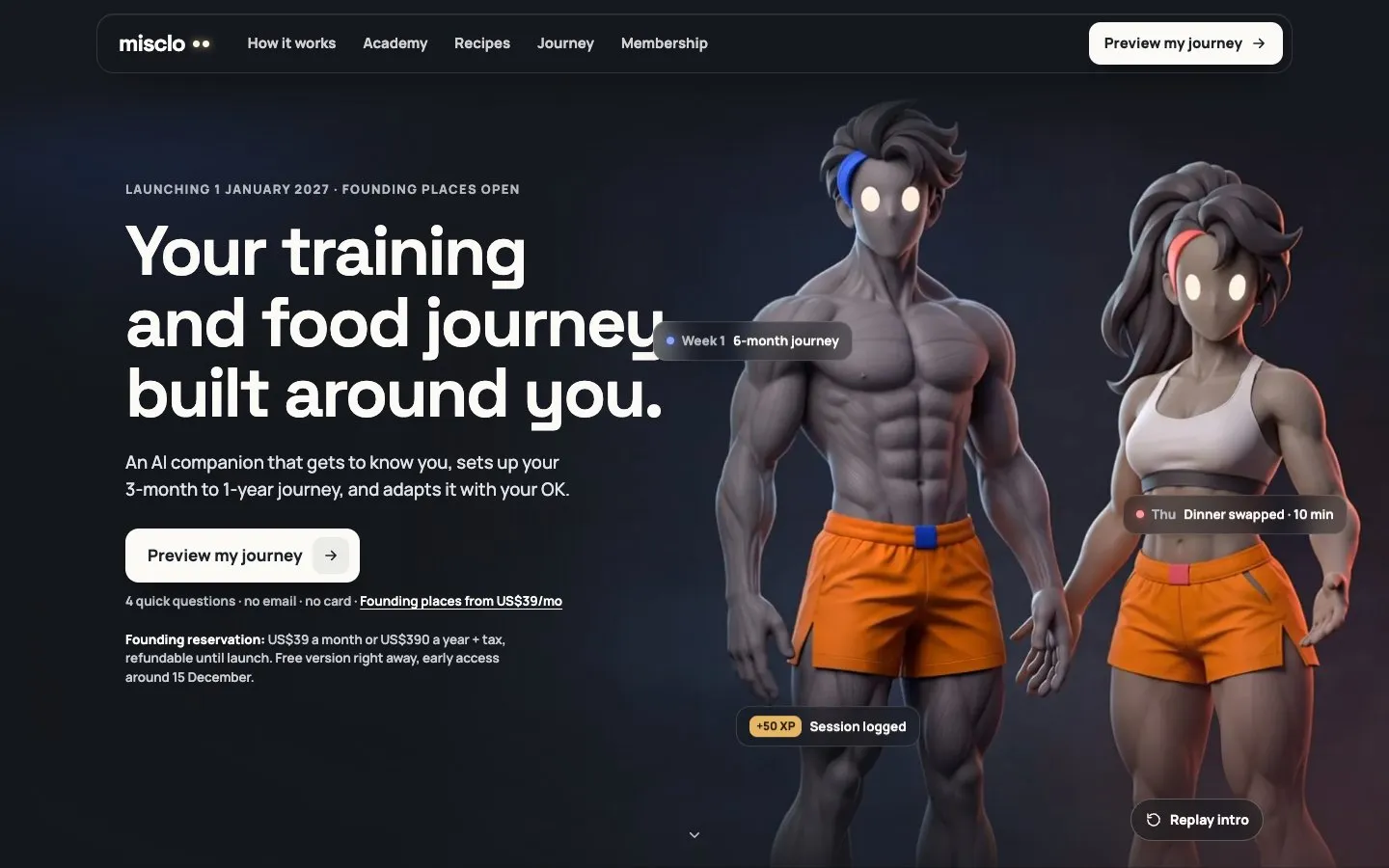

- 228muscles and bones in 21 muscle groups, Misclo body mapAnatomy model by Alex Lashko
- 17.6sone finished reel, from a research, render, voice and compose pipeline
Misclo is in development and not on sale. Character art in the Misclo film and images is AI-generated under my direction.
How I work
Show first. One change at a time. AI does the work, I own the decisions.
These aren’t slogans. They’re the rules my files enforce, and they’re what you get if you hire me or take the challenge.
Show first
Nothing replaces the approved version until you’ve seen the new one next to it. On Misclo, the previous version of the site stays running as the rollback while the new one is a candidate. Nothing moves until the owner says yes. On my own projects, that owner is me. On yours, it’s you.
One change at a time
Each change is small, numbered and kept. Every look and fit on Theo is a numbered, kept step, and approved files are kept as numbered versions instead of being overwritten. When something breaks, I know which step did it, and going back is one step.
Measure, don’t eyeball
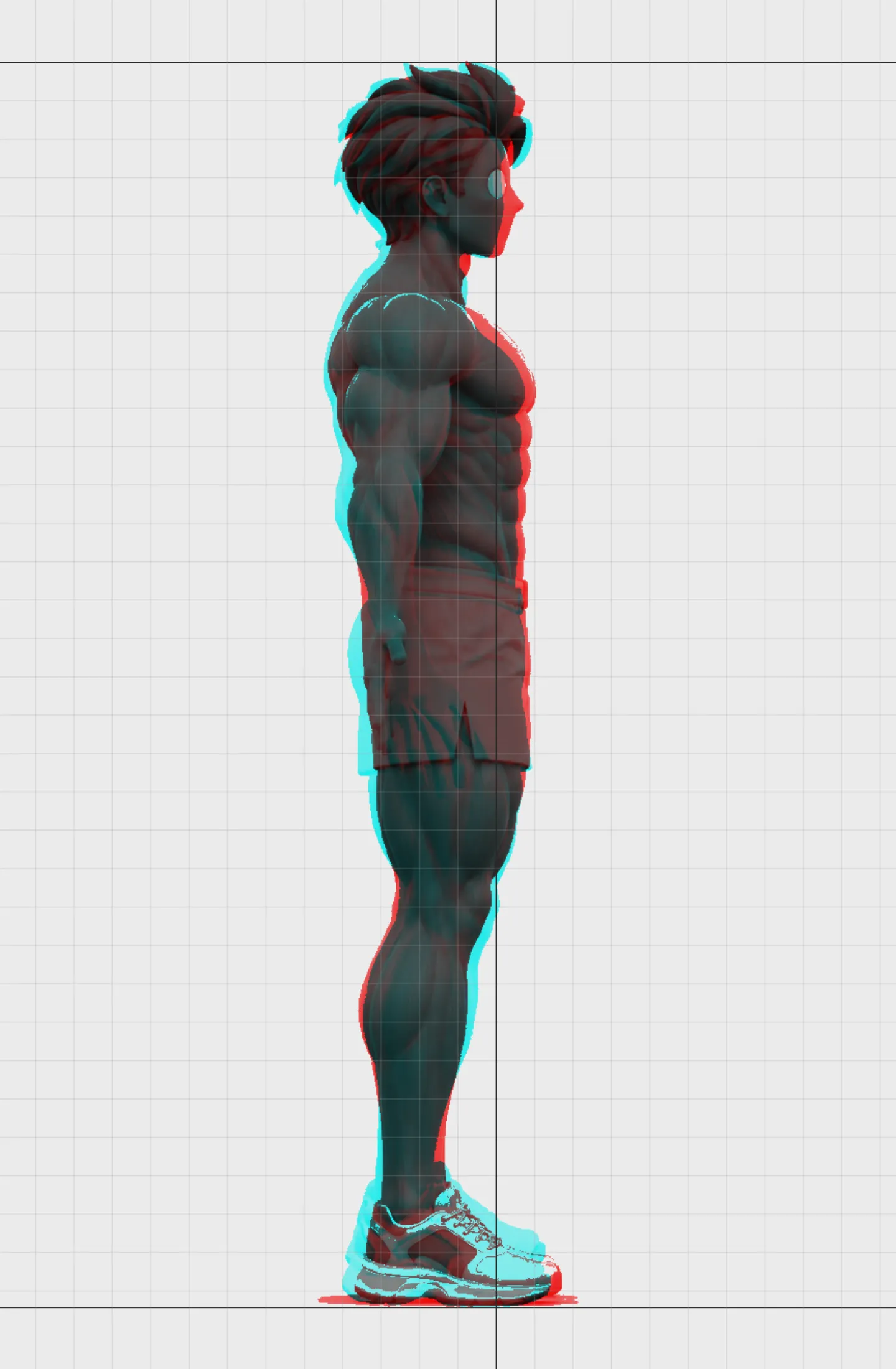
When Theo had to match his reference art, I didn’t squint at it. Every change was laid over the reference at the same figure height, red for the reference and cyan for ours, and a script solved the reference camera. If a change can be measured, I measure it.
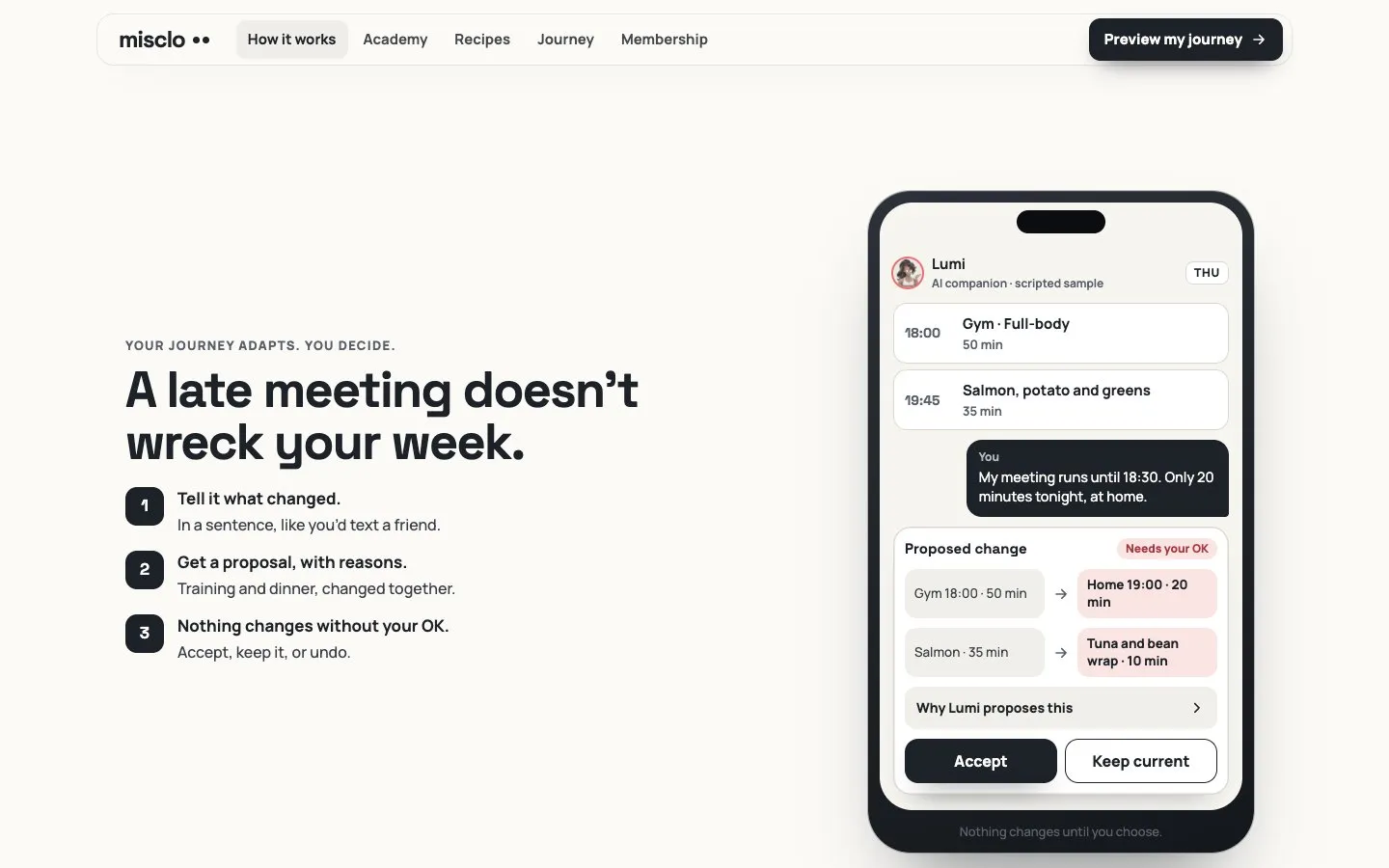
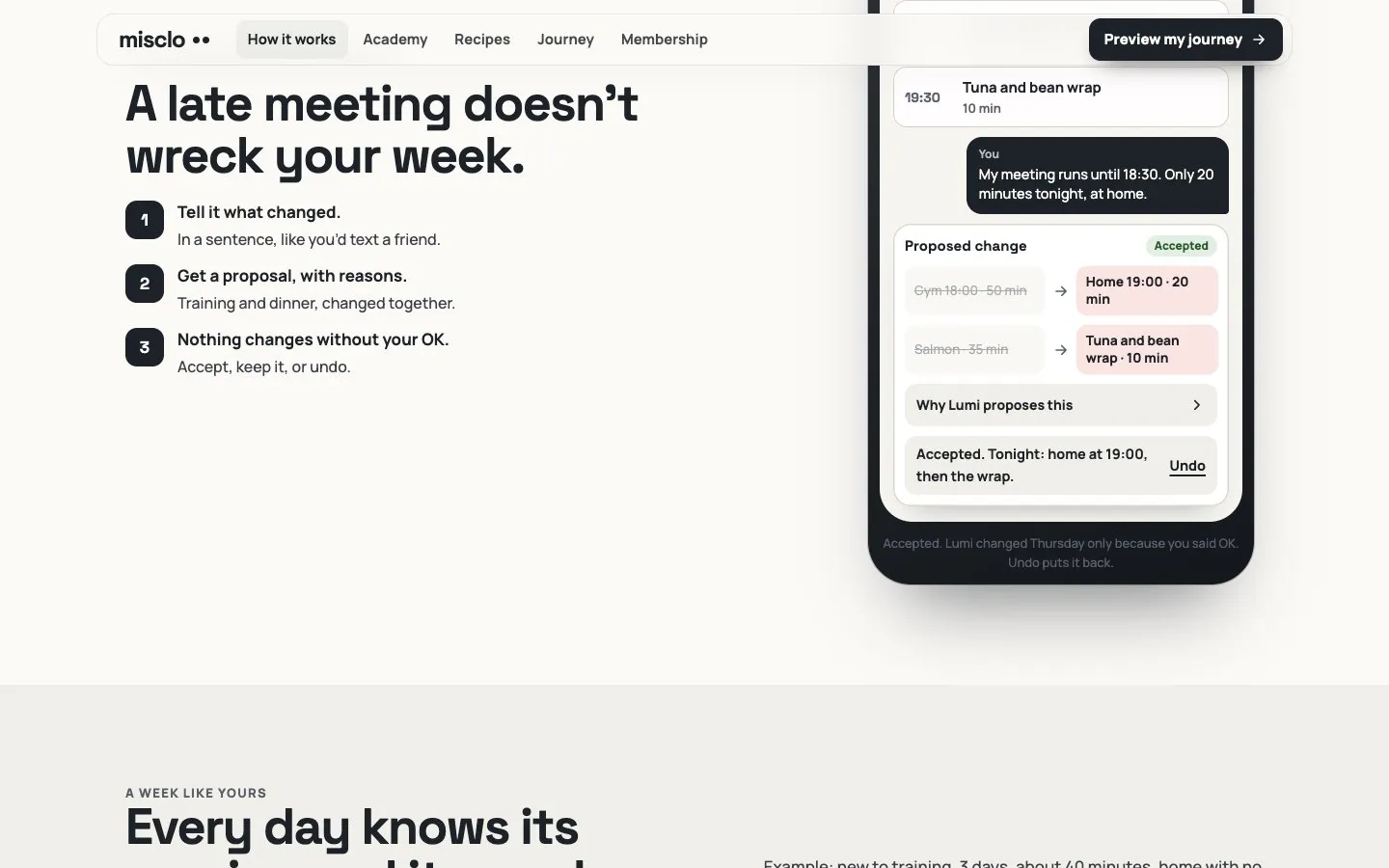
Proposed: Misclo phone screen: a late meeting leads the AI companion to propose a shorter home workout and a quicker dinner, waiting for the user’s OK. Accepted: The same Misclo screen after the change is accepted, with an Undo link.
Test before I show you
Before a version reaches anyone, automated layout, journey and accessibility checks run against it at phone and desktop sizes, in my local browser lab. I report the results as dated lab notes, not as a certificate.
Write everything down
Every project has a handoff file, so any AI or any person can pick it up cold. When I give feedback, it’s saved word for word and quoted in the next report. Decisions have dates. Nobody has to remember what was agreed.
Report the mistakes too
Every report has a Slipped section: what went wrong, which rule it broke, and what changed so it doesn’t repeat. The change note below shows one, in a fictional example. A process you can trust is one that tells you when it slipped.
What this means for you: you see each change before it lands, you can always go back one step, and every decision is written down with a date.
What working with me looks like on paper
Every change arrives like this.
This is the shape of a change note. You get one for every change, before anything goes live.
Fictional example. Real change notes never contain passwords, API keys or customer data.
- Asked
- “Make the pricing card easier to scan on phones.”
- Scope
- Pricing card only. Nothing else moves.
- Shown
- v13 (approved, still live) next to v14 (candidate) at 390 px and 1440 px wide.
- Checks
- Layout at 7 screen sizes · keyboard path · colour contrast
- Slipped
- First draft cut the price line at 360 px. Caught by the layout check, fixed before you saw it.
- Made by
- Claude (layout and code) · reviewed by Aymane
- Rollback
- v13 stays live until you approve v14.
- Status
- Waiting for your OK.
The team
Here’s my team. You’ll always know which part AI made.
I don’t hide the tools, because naming them is part of the honesty. This is the split on Misclo today.
| Lane | Who | What it does |
|---|---|---|
| Direction | Me | Decisions, briefs, every approval, every purchase, the final word |
| Design and code | Claude | Interface, code, internal tools, test scripts, written reports |
| Parallel code | Codex | A second code lane with its own brief |
| Film and images | Image and video models | Brand film and character art, under my direction |
| 3D base mesh | Tripo | Generates Theo’s starting mesh from my brief |
| 3D, voice, edit | Blender, plus voice and editing tools | Driven by scripts Claude wrote; nothing posted without my OK |
How a change moves
- My decision
- Brief
- AI lanes
- Automated checks and measured overlays
- My approval
- Next version
The previous version is kept as the rollback.
Every tool is third-party and named as such. Models and assets made by others are credited, like the anatomy model by Alex Lashko.
What I stand for
Proof I can show, or nothing at all.
Selling AI attracts a lot of big promises. These are mine instead.
I show work, not adjectives.
If I say I can build it, there’s an artefact on this site you can open.
I don’t invent proof.
No made-up testimonials, results, member counts or logos. When real ones exist, with permission, they’ll go up.
I don’t promise income.
I’ll show you how to build the system. What it earns depends on your offer, your market and your work.
I label what AI made.
Films and images are marked as AI, every time, and so will the AI version of me.
One human owns every decision.
AI drafts, builds and checks. A person approves. On your project, that person is you.
Small and reversible beats big and clever.
One change at a time, with the last good version kept.
Your secrets stay out of prompts.
Passwords, keys and customer data never go into a chat window. Before we start, I’ll tell you which tools touch your data.
I credit other people’s work.
Third-party models, tools and assets are named.
Aymane Hitmi
Also on my “won’t do” list: countdowns that reset, fake “only 3 spots left”, calling something launched before it is, and selling a tool I haven’t used myself.
The AI version of me
Soon, some of my Instagram reels will be presented by an AI version of me. Here are the rules it will follow.
I’m building an AI version of me for Instagram: an AI-generated presenter with my likeness, reading scripts I write or approve. When it goes live, it will follow every rule below, and this section will link to the first labelled reel.
This is the AI version · not posting yet
- Always labelled. An on-screen tag, Instagram’s AI label and a line in my bio.
- I write or approve every script. Nothing goes out without my OK.
- It never says more than this site does. No prices, results or promises that aren’t already on these pages.
- It’s never live. Live hours, hot seats and calls are me, in person, on camera.
- It isn’t Theo. Theo is the 3D trainer character in my Misclo lab. He’s not me and doesn’t speak for me.
Working with me
Start free, or have me build it. Here are the main doors.
Most people start with something free and decide from there. If you already know what you need, skip straight to the call.
| Door | Who it’s for | What you get | Price |
|---|---|---|---|
| Free library | Anyone | Expert-level tools, no email wall | Free |
| AI Business Build Week | Starting a business, or running one | Five live days, two tracks, one deliverable a day | Free |
| Solo Launch Build | Challenge graduates starting from zero | Your launch, built for you, shown first, one change at a time | From $990 |
| Business owners | A straight answer on where AI fits and the next step | Free | |
| Personal AI Audit & Implementation Roadmap | Owners who want a plan | Your AI roadmap, written for your business | $970 |
| WebsitesFrom $1,600PlatformsFrom $1,200ContentFrom $1,200AutomationsFrom $850 | Owners who want it built | Scoped builds, shown first, one change at a time | From $850Scoped after a free call |
Prices come from one place and update everywhere at once. The call ends in one of four honest outcomes: do it yourself with my free tools, the Audit, a direct build proposal, or “not a fit”. After a build, I can also stay on as your AI Operations Partner; terms come with the proposal.
Contact
Every message reaches me.
The fastest route is a 15-minute call. If you’d rather write, email me and I’ll answer myself.
- contact@labgenz.com
- Calls
- Where
- Based in Bali, working with clients remotely.
Questions
The things people ask before they book.
Is Labgenz an agency?
No. Labgenz is my lab. It’s me, working solo, with AI doing the work a team used to do. When you work with me, you work with me.
Were your 45+ projects built with AI?
No. They were built over my career, mostly with human teams. Building solo with AI is my current chapter, and it’s shown on this site as it happens.
Why don’t you name your clients?
Because they haven’t agreed to it yet. I describe the problems I solved instead. Names go up only with written permission.
Is the person in your Instagram reels really you?
Yes, today it’s me. Soon, some reels will be presented by an AI version of me, and every one will be labelled. Calls, live sessions and this site are always me. Details on the AI disclosure page.
Do you have testimonials?
Not on this site yet, and I won’t invent any. Judge the method by the work in the lab and the free tools you can open today.
What happens to my data if we work together?
Passwords, keys and customer data never go into prompts. Before we start, I list the tools that will touch your data and why, and you approve them.
I just want to learn. Is this for me?
Yes. Start with the free library or AI Business Build Week. Both are free, and neither needs a call.
Your move
Now you know how I work. Pick your door.
I run a business
If you run a business and want AI working in it, book 15 minutes and I’ll tell you where I’d start.
I’m starting from zero
If you’re starting from zero, take the free week and build alongside me.
Open the free blueprintJust browsing? Open a free tool. No email needed.