The Lab · last updated
Real builds, dated, with the receipts: reports, checks, approvals.
Most portfolios show the finished picture. I’ll show you how each build was made: the brief, which AI did which job, what I decided and approved, how it was measured, and where it stands today, with the date.
The four lab entries are my own projects, built solo with AI as my team, and none of them is launched yet. I won’t pretend otherwise. Below them is the career work I did with people: client platforms my team delivered, and two software products I built and shipped. What you can judge is the craft, the process and the discipline. Those are what you’d be hiring.
How to read this page
Every build carries a status and a date. Here’s what each one means.
I label work the way I’d label it for a client: plainly, with the day it was true. If a label changes, the date changes with it.
- Approved
- I signed it off on the date shown. It’s the version that stays until I approve a replacement.
- Staging
- Built and tested in a local browser lab. Not public, not on sale, no real users.
- Draft
- Work in progress. Shown so you can see the process, not as a finished result.
- Career
- Client and product work from my career. Clients are named only with their written permission.
A status is a fact about the build, never a promise about your project.
The builds
Four lab entries and the career work behind them.
Filter by what you’d want built. Each card opens its full write-up further down the page.
5 builds
17.6sone finished reel from the content engine
- Owner decision
- Brief
- AI lanes
- Checks and overlays
- Owner approval
- Next version
Platforms, academies, integrations
Next in the lab: the funnel this site runs on, once it’s live.
How do you earn trust for an app nobody has heard of? Show it working.
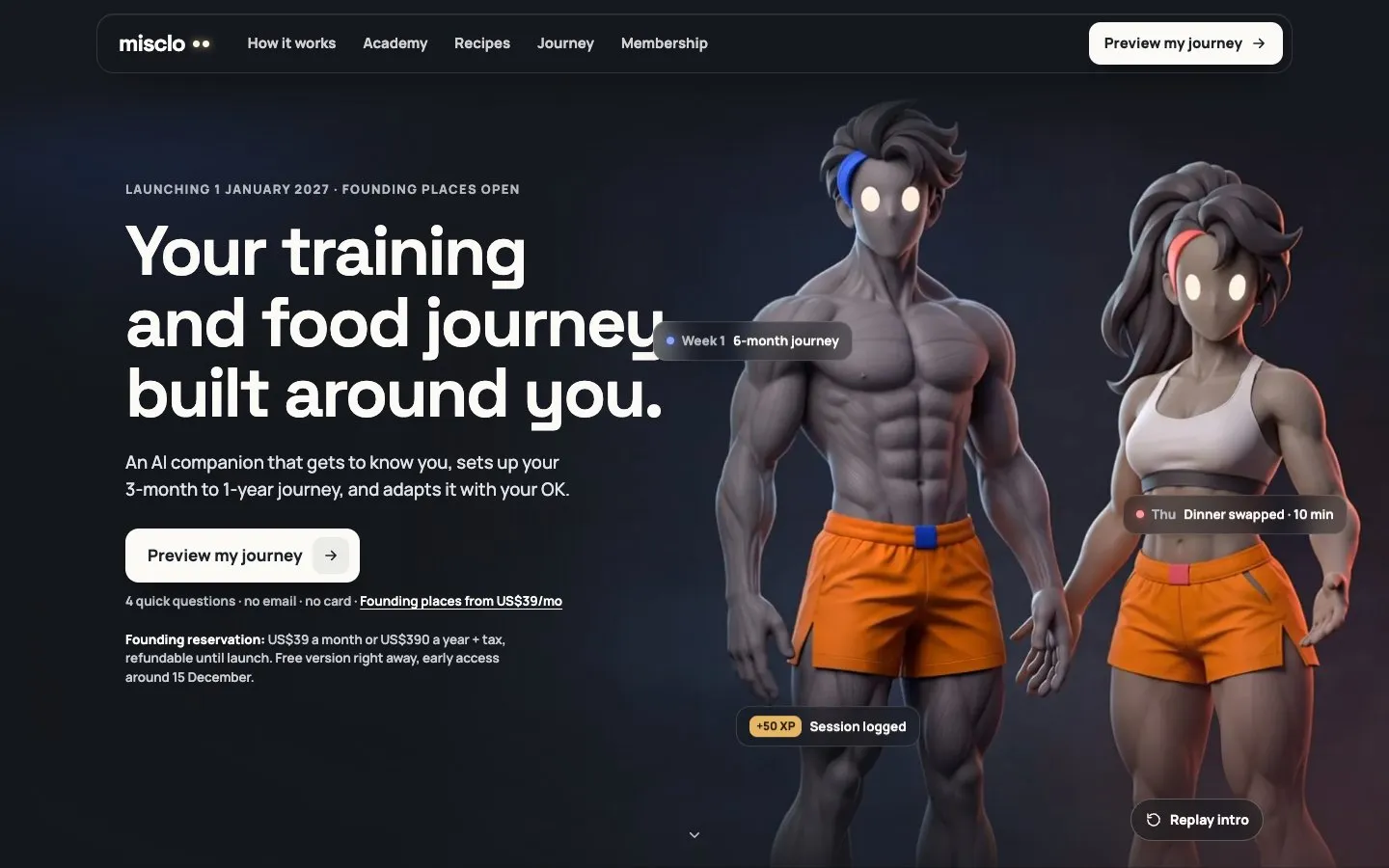
Misclo is my own fitness and food app, in development and set to launch on 1 January 2027. A new subscription app has no reviews, no app-store page and no users to quote. A cold visitor has seconds to understand “an AI companion that plans your training and food” and decide whether to keep reading. A standard SaaS landing page with three feature cards doesn’t do that job.
So I built the marketing site as an experience: the visitor sees the product think instead of reading about it.
What I built
A cinematic entrance
A muted film plays once, with Skip and Replay, then hands over to the headline. Phones get a lighter cut, and reduced-motion or Save-Data visitors get a still poster.
A guided demo
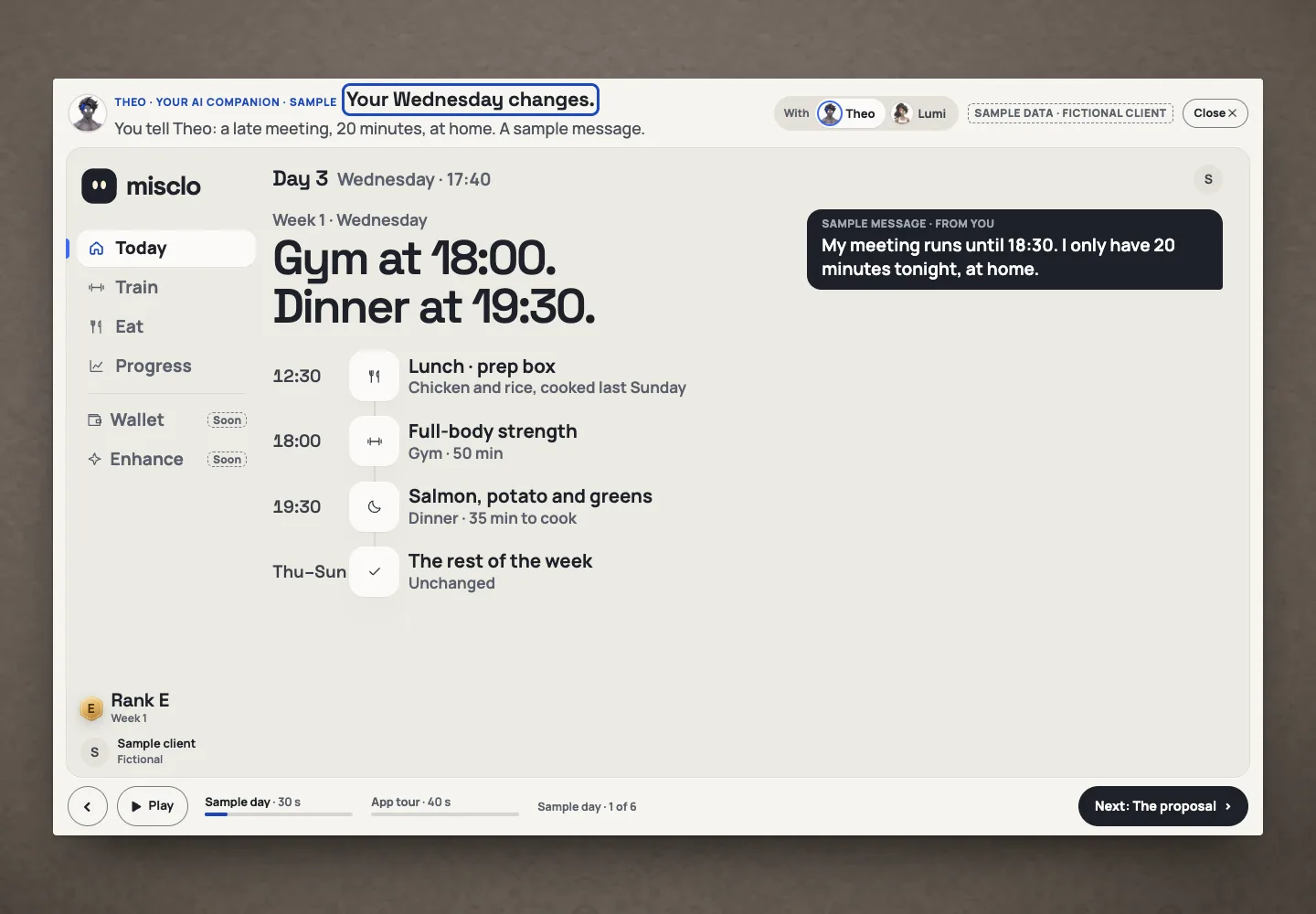
A scripted sample day inside an app frame, in chapters (Today, Train, Eat, Progress).
An adaptive plan preview
Four tap questions, no email, and a sample first week the visitor can accept or undo.
A journey page
Intake, baseline tests, a 3, 6 and 12-month timeline on a real calendar, and an “adapting” screen where the AI proposes and the person decides.
A WebGL 3D body map
228 muscles and bones in 21 muscle groups, man and woman (the woman’s view is an approximation, and the app says so), front, side and back, coloured by the sets logged. Anatomy model by Alex Lashko. It falls back to 2D without WebGL and has a keyboard-friendly muscle list.
A founding-reservation flow
Every state written out, and a request/response contract ready for a real checkout.
- loading
- invalid
- duplicate
- verify
- created
- failure
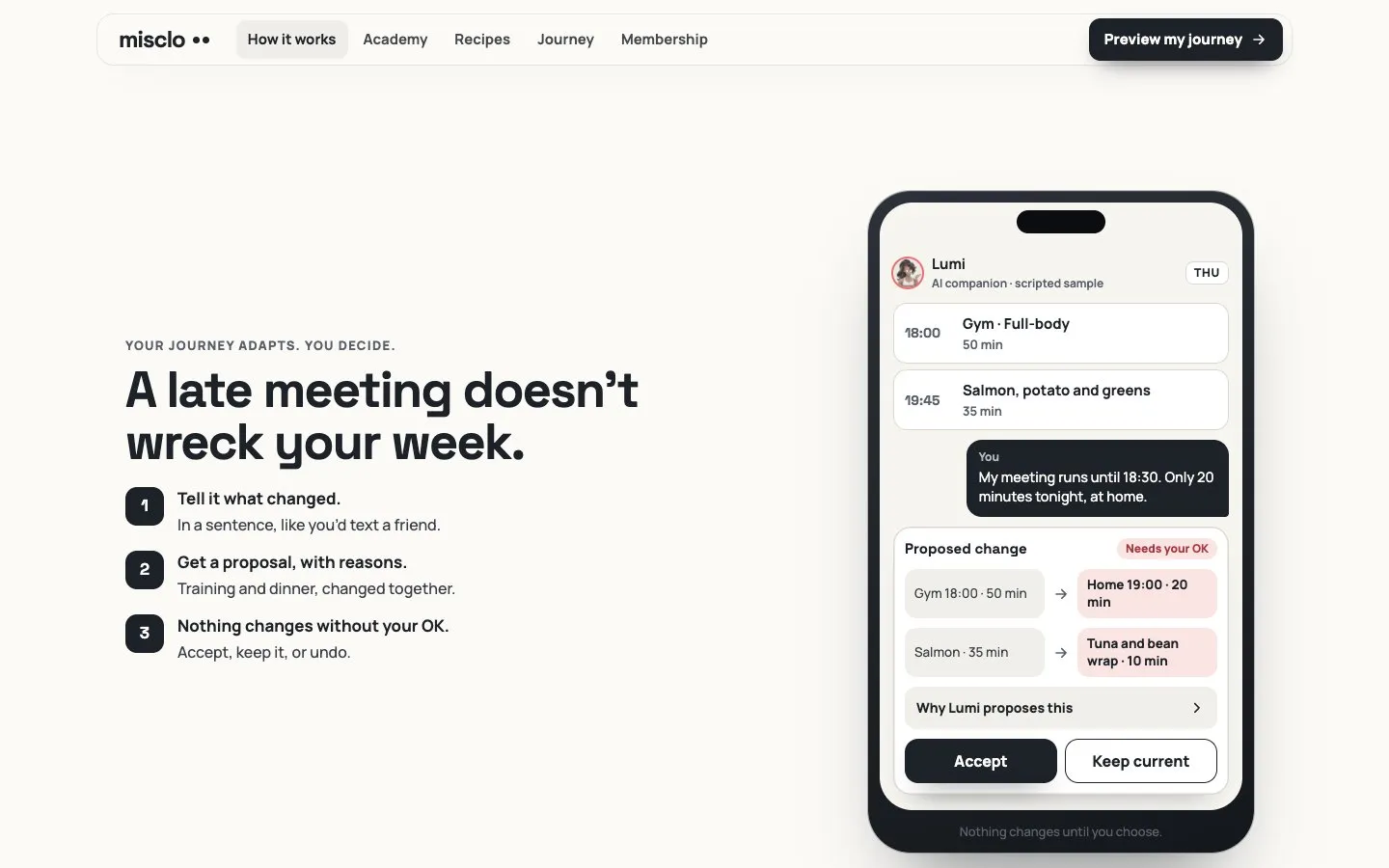
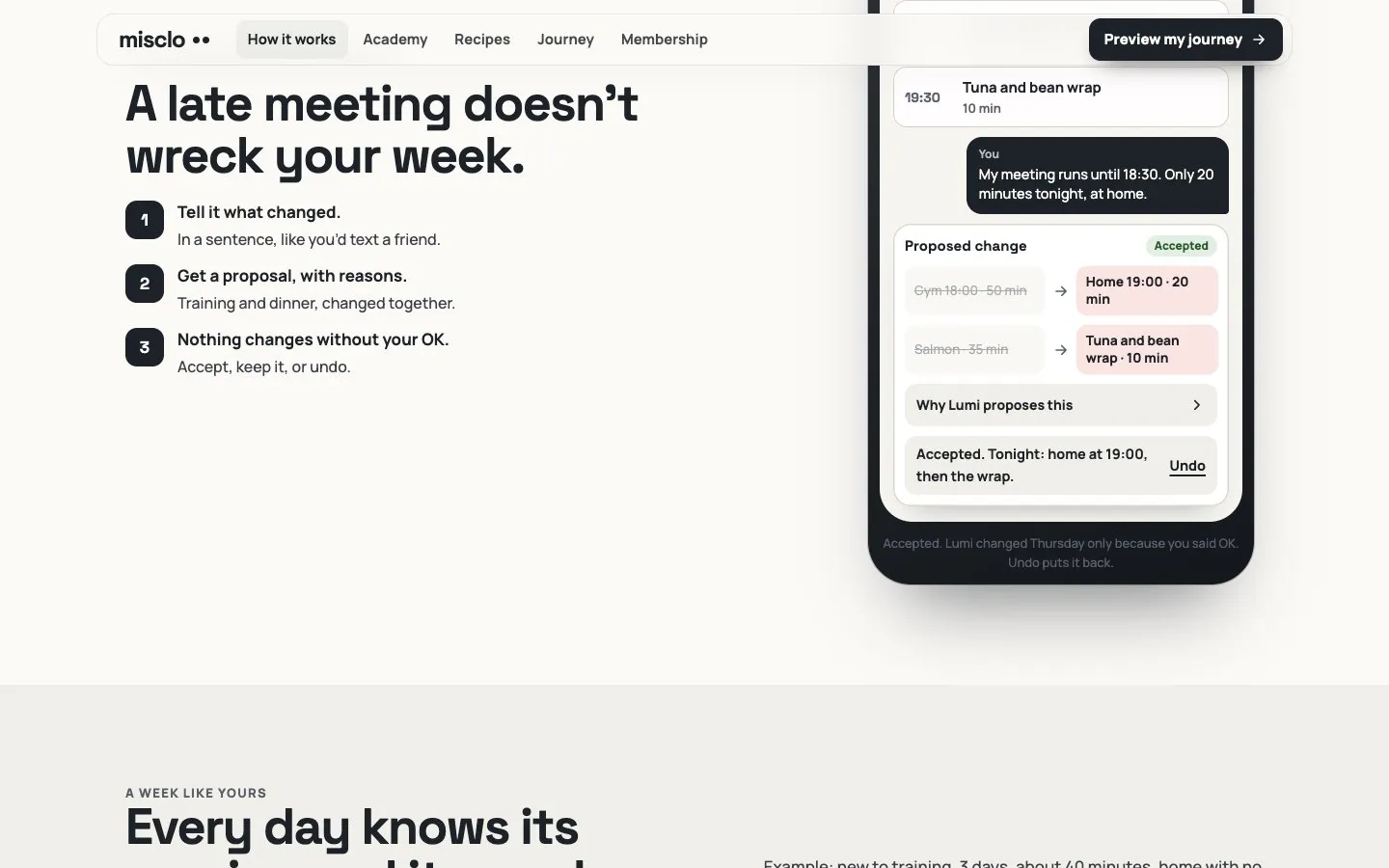
Proposed: Misclo phone screen: a late meeting leads the AI companion to propose a shorter home workout and a quicker dinner, waiting for the user’s OK. Accepted: The same Misclo screen after the change is accepted, with an Undo link.
How it was built
I built it version by version. Each version lived in its own folder, the previous one stayed untouched as the rollback, and each came with a written report and a test run. I wrote down every product decision (price, launch date, which disciplines the app covers) and kept my feedback word for word, so no AI could drift from what I’d actually said.
Before I looked at v7, it had to pass the scripts: layout checks at phone and desktop sizes, the journey page, overlap checks across screen sizes and an automated accessibility scan. All of that ran in a local browser lab, not on a live site.
Me
- Product decisions, copy direction, every approval
- Splitting the work: who owns media, who owns code
- Relaying briefs between lanes
My AI team
- ClaudeAll UI/UX, HTML/CSS/JS, the anatomy conversion tool, the test scripts and the reports
- ChatGPT with HiggsfieldThe entrance film and the character art
- CodexA parallel code lane
Where it stands
- Staging candidate v7, 9 Nov 2026. Not public, not indexed, no backend connected.
- Sign-up, checkout and the seats counter are switched off until real endpoints exist, and the page says so at the moment you’d act. Nothing can be charged by mistake.
- Exercise and anatomy content is waiting for expert review.
Misclo is pre-launch: no users, no reservations, no results claimed. The character art and the entrance film are AI-generated under my direction. They are not renders of the Blender Theo in the next entry. Anatomy model: Alex Lashko.
A 3D trainer who looks the same in every clip, without a 3D studio.
Misclo needed a trainer character that could demonstrate exercises correctly, show which muscle is working, and be rendered at volume. Image and video AI can’t hold one character steady across hundreds of clips, and my rule for this project is in-house only: no studio, no freelancers. So I built a pipeline instead of a picture.
ReferenceTheoWhat I built
The base mesh
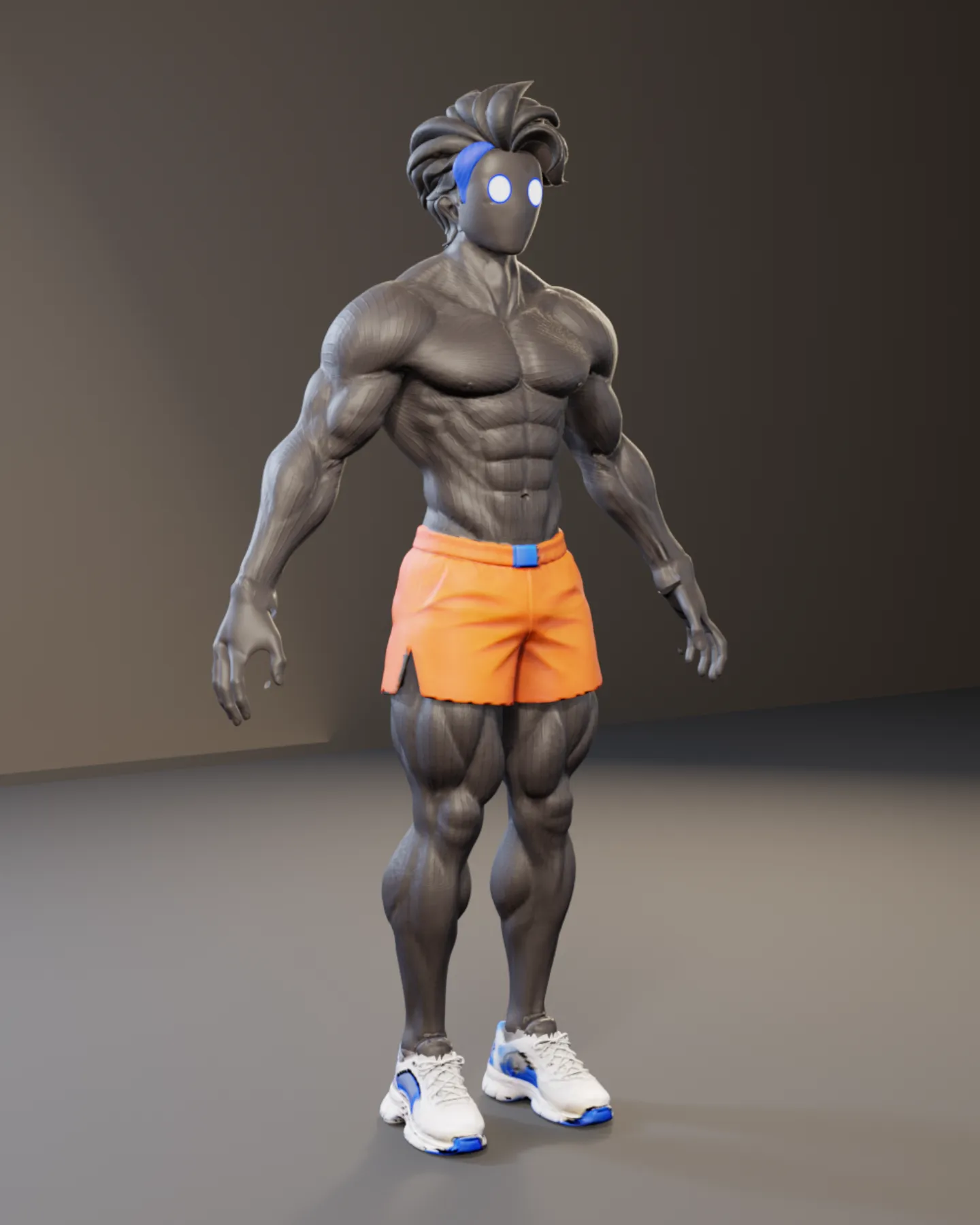
Generated in Tripo, an AI 3D generator. I run every Tripo job myself, and Theo’s face comes from a Tripo bust I made.
The rig
A scripted build chain fits that mesh onto a full human rig in Blender, covering proportions, head, face transfer and fixes, then outputs model sheets.
Measurement
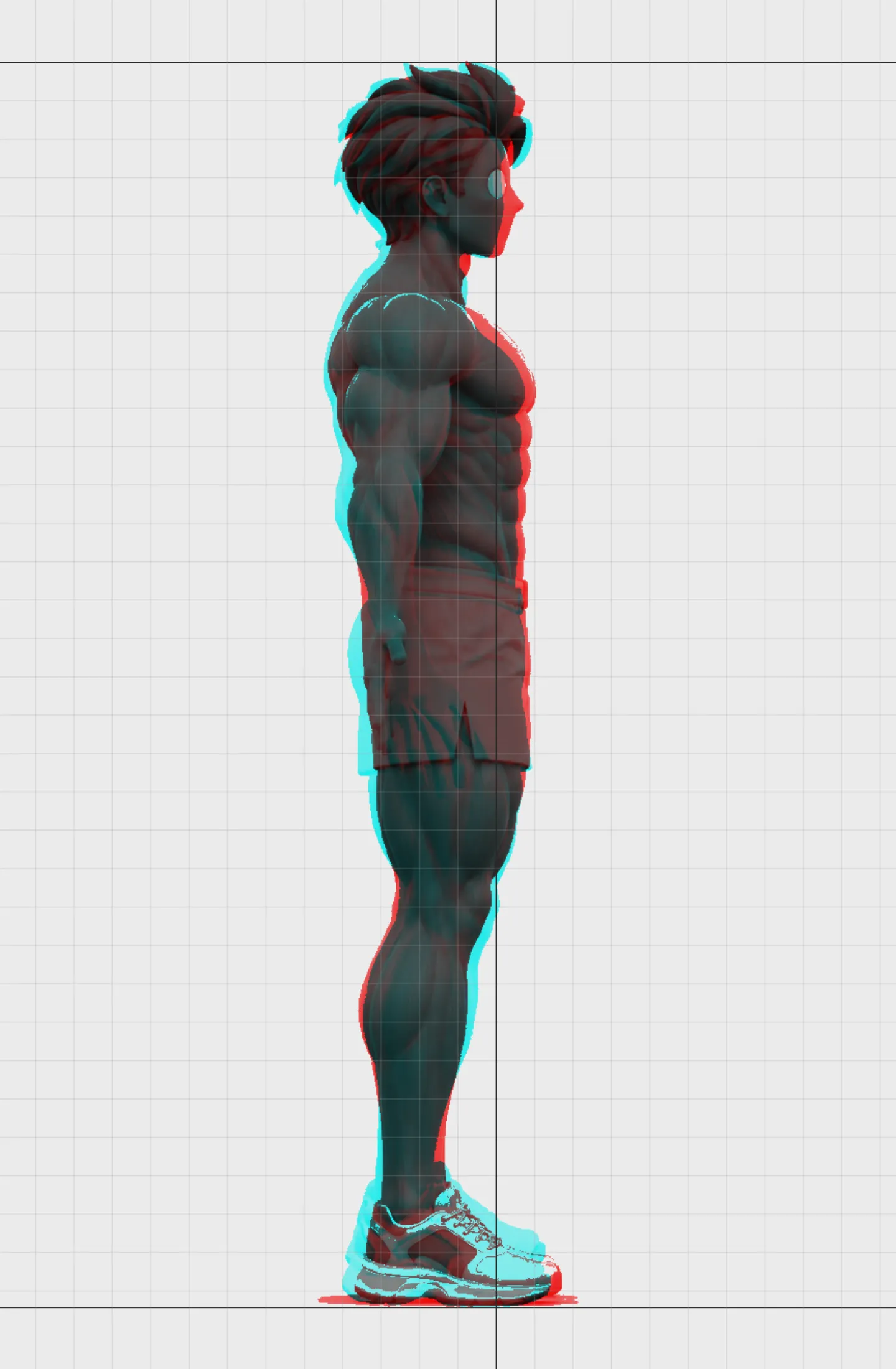
Every change is overlaid on the reference art at the same figure height, red for the reference and cyan for Theo. Landmark tools report widths and eye, nose and chin lines, and a camera solver matched the reference camera.
Motion and form
Bought gym motion capture is retargeted onto Theo, and “wrong form” variants are made by adding a measured error to the correct movement, like an elbow drifting forward. Joint angles are read back from the rig, so form is checked with numbers.
X-ray anatomy
Muscles from a licensed anatomy model are warped inside Theo and bound to his skeleton. A glass-skin material lights the working muscle blue.
Versioning
Every look and fit gets a new number, approved files are never overwritten, and the scripts can’t delete anything.
Who did what
Me
- Generated the mesh and the bust, set the look, approved each visual step
- Chose and paid for every purchase (motion pack, rigging add-on, anatomy model)
My AI team
- TripoThe base mesh
- ClaudeWrote and runs the Blender and Python tools for building, measuring, retargeting, rendering and x-ray, and documents every step
Where it stands
- ApprovedLook-29 / fit 39 on 7 Nov 2026, and the x-ray anatomy on 8 Nov 2026.
- DraftThe full exercise library. The first motion clips are stiff pilots.
- Known limitsSome x-ray seams remain, and they’re written down.
Theo’s mesh is AI-generated, then rigged, measured, animated and art-directed in-house with AI-written tools. He wasn’t hand-sculpted, and the anatomy isn’t medically validated. Anatomy model: Alex Lashko. Rig and model files are never offered for download.
A content engine is a pipeline with gates, not a prompt that writes captions.
Short-form video needs volume, a repeatable format and fast learning, at a quality that stands out from faceless accounts. One person doing it by hand doesn’t scale. So I built the engine in stages, each one a script with a quality gate. It produced one finished 17.6-second reel on 9 November 2026.
Out of the engine so far
17.6sone finished reel from the content engine
The stages
Research
A script analyses reels I approve for study and records length, transcript, words per second, time to first speech, cuts per shot and loudness. It builds an outlier database of what holds attention and why.
Templates
Formats are taken from structure, never from anyone’s wording. Drafts so far run from a short form fix to a numbered “start here” series with a keyword call-to-action.
Render
Presets for camera, background and glow render passes, not finished shots, so one render serves many edits.
Voice and sound
AI text-to-speech with word-level timings, so captions sync without a second transcription pass. The voice is a library voice I chose, not mine and not a clone.
Compose
Captions, labels, arrows and wipes assembled in code, with audio mixed to a consistent loudness.
Gates on every video
- A hook in the first second
- A visual change every 2 to 3 seconds
- A reason to save or send
- Safe claims
- A sign-off
The first finished reel
“Muscle Map: dumbbell curl, with x-ray”
17.6 seconds. The reel stays off this page until its licences are confirmed, so here it is beat by beat.
A gym orbit opens it.
An x-ray flash shows the biceps lit blue.
The wrong rep: the elbow drifts and the front shoulder glows red.
The fix runs on the same camera. The red wipes to blue and the elbow stays pinned.
One line to save it, then the outro.
Who did what
Me
- Picked what to study, approved each research batch, chose the voice, reviewed every storyboard and the final cut
- Own the accounts and every decision to post
My AI team
- ClaudeThe analysis, render, compose, voice and build tools, the strategy documents and the storyboards
- ToolsLocal transcription, AI voice and music, Blender, Remotion and ffmpeg for render and assembly
Where it stands
- FinishedOne reel, SB-01 v2, on 9 Nov 2026.
- Rejected on purposeAn earlier demo with a placeholder voice. My rule since then is style frames and a storyboard before any video.
- DraftThe templates, the posting plan, and the scheduler and job runner, which aren’t built yet.
- Not postedNothing from this engine is public yet, so there are no views, followers or saves to report.
The view counts in my research database belong to the accounts studied, not to me, and their material is never republished. Capacity figures are plans, not results. An AI version of me for Instagram is planned as a separate build, always disclosed. It gets its own entry here when there’s something finished to show.
The habits I learned leading 12 developers, rebuilt for an AI team.
AI is fast and confident, and both of those can work against you. What keeps a build on track is the same thing that kept agency projects on track: a written brief, one owner, small changes, measurement, and a rollback. Here’s the method as I run it, with the evidence from the builds above.
Step 1: Write the brief, and keep the owner’s words exactly
Every project starts with a brief, and every piece of feedback I give is saved word for word in the project. When an AI picks up the work, it reads what I actually said, not a summary of it.
Step 2: Give each AI one lane, with a written contract between lanes
Claude owns UI, code, tools and QA. ChatGPT with Higgsfield owns media. Codex works a parallel code lane. Where lanes meet, such as a checkout backend or a media request, there’s a written contract that says exactly what goes in and what comes out.
Step 3: One change at a time, shown before it replaces anything
Each version gets a number. The approved one stays where it is, the new one is shown beside it, and nothing replaces it until I say yes. The previous version is always kept as the rollback.
ProposedAcceptedMisclo applies the same rule to its own users: the AI proposes, the person accepts · scripted sample Step 4: Measure before you show
Automated checks run before I look: layout at several screen sizes, accessibility, overlap, slow-network behaviour. For visuals, overlays against the reference at the same scale. If it isn’t measured, it isn’t ready.
Red: reference. Cyan: Theo. Same figure height. Step 5: Gates for money, permissions and honesty
Nothing is bought, sent, posted or downloaded without my OK. Features that aren’t connected say so at the moment you’d use them. Files are checked against recorded fingerprints so nothing changes silently. And mistakes get written down: one Misclo report records an AI deleting a cache folder against my “Trash only” rule. That’s in the report, not hidden from it.
Step 6: Hand off so anyone can resume
Every project carries a handoff file: what exists, what’s approved, what’s blocked, what to read first. Another AI, or another person, can pick it up tomorrow without me in the room.
Every stage ends in a report
Each stage of a build also ends with a fixed report, the OS-REPORT block. The project and values below are fictional, for illustration only.
OS-REPORT
status: needs-input
produced: booking section v5 (booking button moved above the menu on phones); before/after shots at 390 and 1440 wide
checks: layout at 390 and 1440 wide: pass, shots attached · accessibility scan: pass, 0 violations · overlap at 7 sizes: pass
decisions-needed: approve v5 to replace v4? v4 stays unchanged as the rollback.
next: on approval, connect the booking form to the test calendar28+client platforms my team delivered and maintained, as CTO of a US marketing agency
Career · client and product work
The hard part of a platform isn’t the code. It’s the structure underneath.
Before I built with AI, I built with people. Across my career, the projects I’m proudest of share one trait: real-world structures that don’t fit a template. Schools inside a network. Families inside a membership. A course, a test, a certificate and a purchase that have to feel like one journey.
AI writes the code faster now. Deciding how those structures fit together is still the job, and it’s the part I bring to your build.
A multi-school learning platform in three languages
Each school gets its own space, its own cohorts and a gamified curriculum. I designed the architecture, the tenant and cohort model and the gamification, and worked with school administrations on rollout.
A certification journey for a premium marketing educator
Course, assessment, certificate and purchase, built as one path instead of four disconnected tools: the course architecture, the assessment flows, automatic certificates and the commerce layer.
A family-account membership system for a national nonprofit network
One account per family, linked member profiles, adapted programmes and reporting for the organisation’s staff. The problem was modelling how families actually join and take part, instead of forcing one person per account.
A private intranet and training academy for a real-estate team
Internal communication, a shared resource library and a structured academy that takes every new agent through onboarding.
Two software products I built and shipped
One connects WordPress sites to GoHighLevel, with a secure OAuth2 connection, two-way sync, and modules for BuddyBoss, LearnDash and WooCommerce. The other adds what organisations need on top of BuddyBoss and LearnDash: course seats per organisation, cohorts per classroom and learner outcome reporting.
These cards describe the problem and what I built. They don’t report client results, and no logos are shown without permission. The longer story is on my about page.
Working with me
You’ve seen how I build. Here’s how that becomes your project.
Every engagement runs on the method above: your brief kept word for word, a stage for every discipline, a version you see before it replaces anything, and your OK before anything is bought, sent or published.
It starts with a free 15-minute call, and one of four honest outcomes:
- You do it yourself with my free tools
- You take the $970 Audit for a full plan
- I send you a direct build proposal
- I tell you it’s not a fit
| If you liked | I build | Starting at |
|---|---|---|
| The Misclo site | Immersive websites | Launch Site $1,600 · Immersive Flagship $3,200 |
| The Misclo product logic | Platforms and apps | Prototype Sprint $1,200 · Focused MVP $4,000 |
| Theo and the reel pipeline | AI content engine with a presenter | Engine + AI Presenter $2,200 · a custom 3D character is scoped on the call |
| The method, run with you each month | Scoped on the free call | |
| Not sure yet | Personal AI Audit & Implementation Roadmap | $970 |
Starting prices are public; your exact scope comes out of the call. I don’t promise revenue, hours saved or results, and I’ll say so on the call too.
Straight answers
No testimonials, no user counts, no view figures. Not yet.
Misclo hasn’t launched, the content engine hasn’t posted, and I don’t have an AI client result to report yet. So you won’t see any of those numbers here, and I won’t borrow other people’s numbers to fill the gap.
What you will see is dated work, the checks it passed, what AI did and what I did. When a client agrees to share a result, it’ll appear here with their name, the date and how it was measured.
- AI-generated media is labelled as AI-generated.
- Third-party work is credited: anatomy model by Alex Lashko, base mesh by Tripo, voice from an AI voice library.
- Lab test scores are my own checks in a local browser lab. They aren’t certifications.
- Career clients are named only with their written permission.
FAQ
Before you book.
Is any of this live?
None of the lab entries is live yet. Misclo is in staging and set to launch on 1 January 2027. The first reel is finished but not posted. Every lab card shows its status and the date it was true. The career work further down was delivered for clients, and those cards describe what I built, not results.
Did you build these yourself, or did AI?
Both, and each entry says exactly who did what. AI does the making: code, tools, renders, media. I make the decisions, set the standard, measure and approve. That split is the method, and it’s what you’d get on your project.
Can you build something like Misclo for my business?
Why are some images missing or on hold?
Some frames include a third-party anatomy model or licensed motion and audio. I’m confirming those licences cover this website before I show them. It’s slower, and it’s the same care I’d take with your brand.
Why don’t you show client logos?
Logos belong to the clients. I’ll show a name or a logo only when that client has said yes in writing.
Can I see the files?
On a call I can walk you through them: the reports, the check runs and the handoff files. Rig files, licensed models and anything belonging to a third party are never shared.
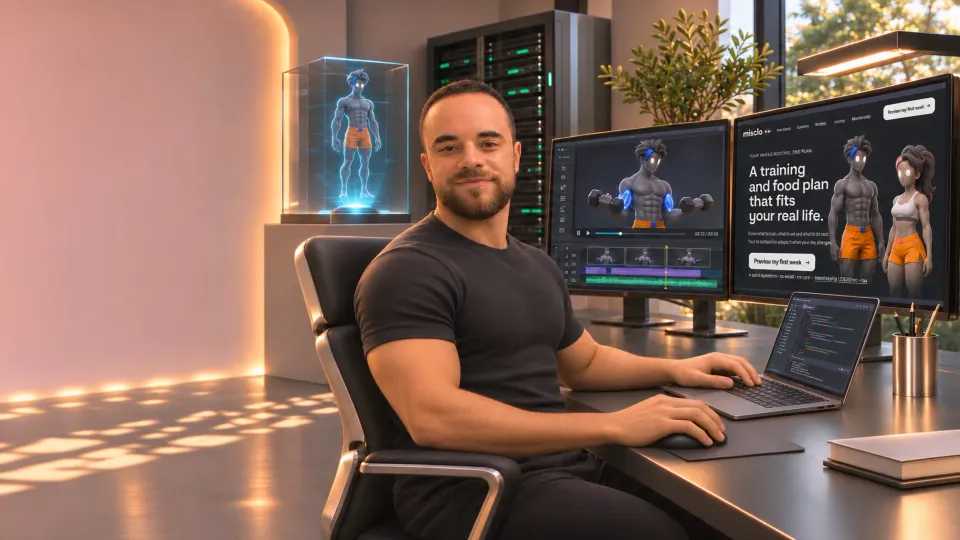
Your move
Bring me the project. I’ll show you the first stage on the call.
Fifteen minutes, free. Tell me what you want to build or fix, and you’ll leave knowing whether it’s a fit and what I’d do first.
Or write to contact@labgenz.com.