Enquiry handling today
Fictional sampleThe setup map
- Website enquiry arrives
- Assistant looks up program details
- Writes a reply
- Owner checks difficult cases
- Sends and updates the tracker
For business owners · Personal AI Audit & Implementation Roadmap
I study how your business actually runs: the tools, the handoffs, the enquiries, the admin that lands on your desk. Then I rank where AI is worth it, where it isn’t, and what to build first.
You get a written plan you can act on: a ranked shortlist, a build-ready specification for the first system, the tools and running costs written down, and a 90-day order of work. Every document is editable and yours.

Who this is for
If you’re starting from zero with no customers yet, take the free AI Business Build Week on the LAUNCH track instead.
And if you already know exactly what you want built, skip the audit: book the call and I’ll quote the build directly.
Starting from zero? The free LAUNCH trackWhy start with a plan
When I ran a team of 12 developers, the costly problems were rarely bad code. They were the wrong thing built first. AI makes that mistake cheaper to make and easier to repeat: a tool bought because a competitor uses it, an automation that sends the wrong message to a real customer, a chatbot with nobody checking what it says.
The audit puts the decision before the build. I look at where work and enquiries actually slip in your business, score each candidate on value, feasibility and risk, and only then specify what to build. Often the best first step is not the flashiest one.
Build comes after the audit, with whoever you choose.
Where I look
These are the places I look. What I find in your business, and what it’s worth to you, is what the audit is for. I don’t promise hours saved or revenue.
What you get
Every document is editable and yours. Build it with me, with your own team or with another developer.
Your main tools, processes and handoffs on one page, including the tasks that quietly eat your week. You’ll see your business the way a builder needs to see it.
Lets you brief any builder from one document instead of re-explaining your setup on every call.
See it in the sampleA shortlist of where AI could help, ranked by value, feasibility and risk. Up to three priority workflows get a deeper assessment: why they matter, what they depend on and what needs testing before anyone builds.
Lets you say no to the ideas that look good and aren’t, with reasons on paper.
See it in the sampleWhich models and tools I’d use, what connects to what, what access is needed, and the monthly running-cost assumptions, written down so you can check them rather than discover them on an invoice.
Lets you keep what already works, and know the cost before you commit.
See it in the sampleFor the first implementation: what triggers it, what goes in, what comes out, where a person reviews it, who is responsible and the checks it must pass before it goes live. Specific enough for a developer to start on day one.
Lets you get comparable quotes, or hand it straight to your own team.
See it in the sampleWhat to do first, what can wait and in what order, with estimated effort for each step and the decisions you’ll need to make along the way.
Lets you move one step at a time instead of starting everything at once.
See it in the sampleA 45-minute walkthrough with me, plus one round of corrections after you’ve read the documents. I take you through the recommendations live, answer your questions and hand over every working document in an editable format. Nothing is locked in a format only I can use.
Lets you own the plan. Build it with me, your team or anyone else.
See it in the sampleIncludes up to $200 of AI research and technical validation where it’s needed, such as testing a model on your real enquiry types. It’s part of the $970, not an extra charge, and not credits handed over to you.
Sample roadmap · fictional business
An excerpt from a sample I wrote for a fictional business, Harbor Learning & Coaching: a coaching company on WordPress with LearnDash and BuddyBoss, where one admin assistant answers every enquiry by hand. The business, its numbers and its tools are invented to show the format. Your audit is written about your business.
The setup map
Each candidate gets three scores from 1 to 5. Value: how often it happens and what a slip costs. Feasibility: clear inputs, a clear start and end, and past examples to test on. Risk: what happens if it’s wrong in front of a customer.
| Opportunity | Value | Feasibility | Risk | Decision |
|---|---|---|---|---|
| Enquiry handling | 4 | 4 | 2 | First: pilot as drafts a person approves |
| Onboarding administration | 3 | 2 | 1 | Second: write the program facts down first |
| Progress summaries | 4 | 3 | 4 | Third: only with a coach approving each summary |
Trigger     A valid website enquiry
Inputs      The enquiry + approved program facts
Output      Summary and reply draft in a review queue
Review      Harbor's admin (a person) approves every draft before it is sent
Owner       Harbor's admin; owner handles flagged cases
Acceptance  Missing facts are flagged; nothing sends automatically
Test 1      20 past enquiries replayed; 0 drafts state a price or date
            not in the program facts
Test 2      Every refund, complaint or health question in the replay
            is flagged to the owner, never drafted as a reply
Go-live Both tests pass on the replay before a live enquiry is draftedHarbor Learning & Coaching does not exist. Notice what the top-ranked idea is: not a chatbot that talks to customers on its own, but a draft a person approves. That’s usually where I start.
How it works
You tell me what you sell and where work or leads slip. I come prepared and tell you straight which of four answers fits: do it yourself with my free tools, the audit, a direct build proposal if your brief is already clear, or that we’re not a fit.
If the audit is the right step, I send a short written scope: the business, the goals, the workflows in focus, what I’ll need from you and a provisional start date. Once you’ve agreed and paid, I send the intake: a short questionnaire and a list of what to share. The day your complete intake arrives, I confirm the delivery date in writing: 7–10 business days later.
I work through your answers, your tool list and a 60-minute discovery session (live screen-share, or recorded if time zones don’t allow) on how a typical enquiry, order or week runs. I ask follow-up questions in writing so nothing depends on memory.
I score every opportunity, assess up to three in depth, and where it’s useful I test a model or tool on real examples you’ve approved for that purpose. Then I write the specification for the first build and the 90-day order of work.
We go through the plan together in a 45-minute walkthrough. I explain every recommendation and what I’d do first, answer your questions, and hand over the editable files. Delivery is on the date I confirmed in writing when your complete intake arrived. After you’ve read the documents, you get one round of corrections.
Steps 3 to 5 take 7–10 business days from the day your complete intake arrives.
How I work
Labgenz is my AI lab. I run it alone, with AI as my team, and I hold it to the standards I used with a team of 12 developers. The same habits go into your audit.
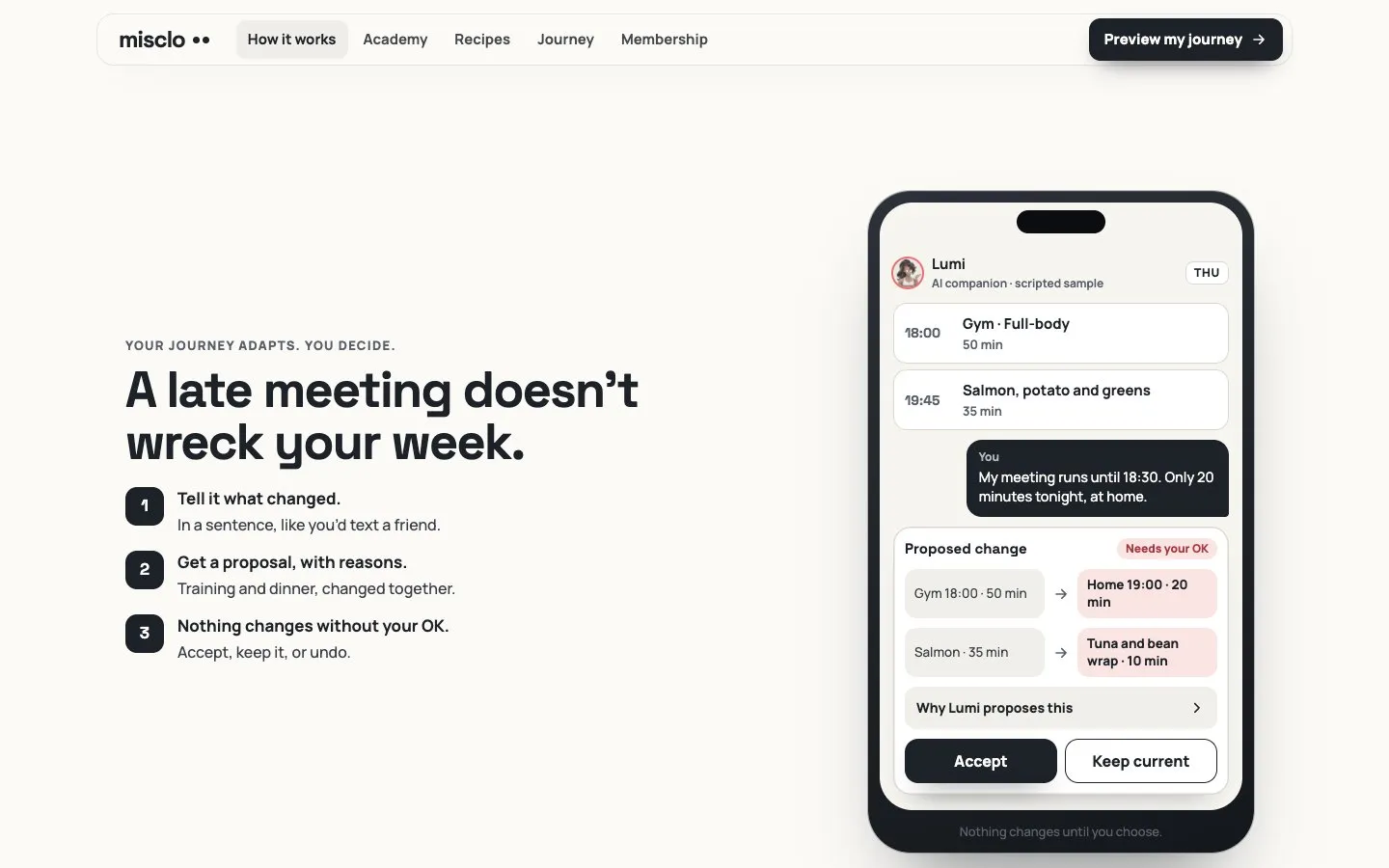
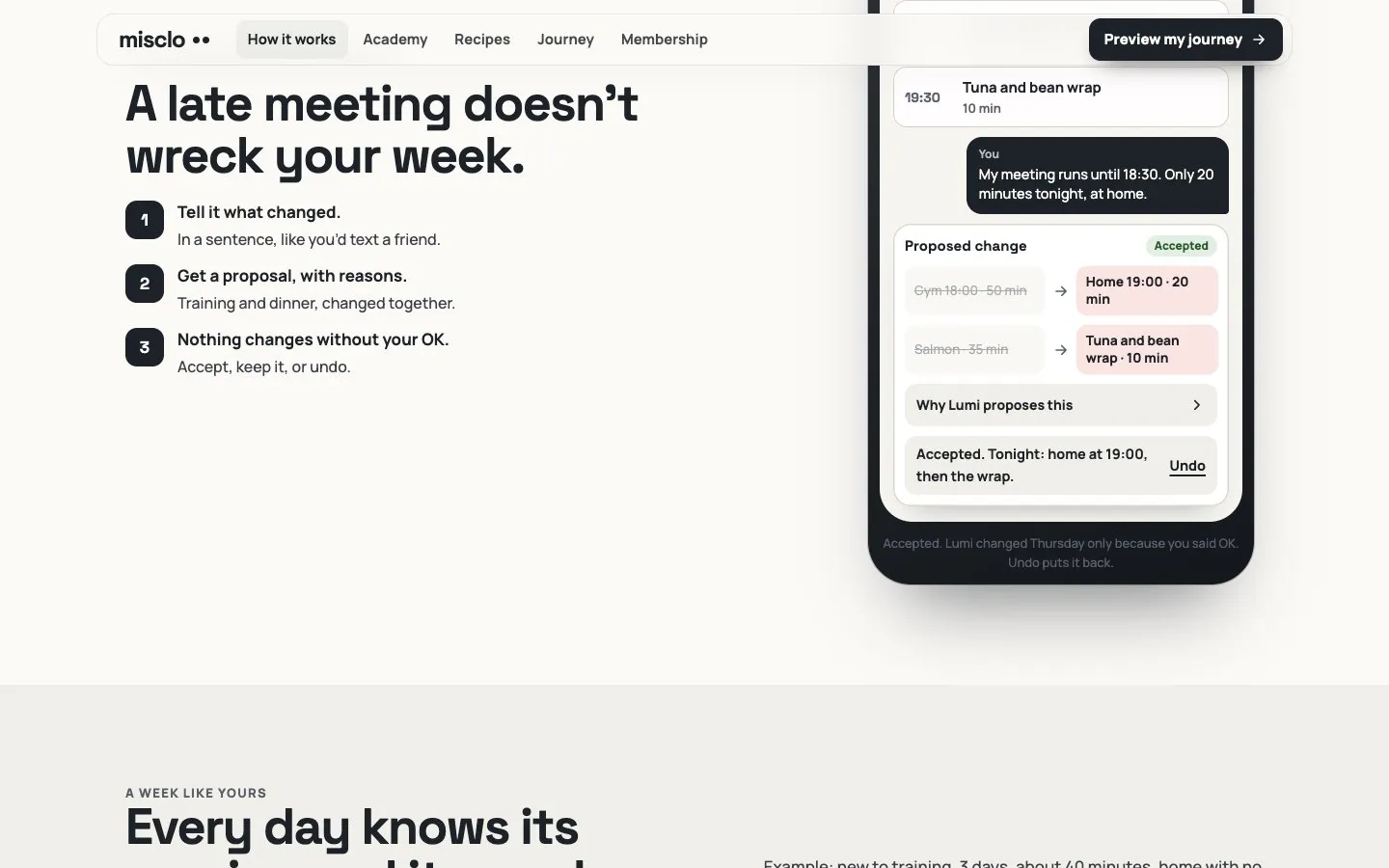
Proposed: Misclo phone screen: a late meeting leads the AI companion to propose a shorter home workout and a quicker dinner, waiting for the user’s OK. Accepted: The same Misclo screen after the change is accepted, with an Undo link.

Misclo is my own fitness app, in development with launch set for 1 January 2027. Each version is shown on staging before it replaces the last, with the previous one kept as rollback. Theo, my 3D character, is a Tripo AI mesh I rigged and animated in Blender with AI-written tools, checked against reference images in same-height overlays. See the builds in my lab

Who does the audit
I’ve sat on both sides of this: the person deciding what to build, and the person responsible when it breaks. I use AI throughout the audit to research, analyse and draft, and I read, check and sign off every recommendation myself. The calls are with me.
On Instagram you may meet an AI version of me. It’s always labelled as AI. The audit, the calls and the walkthrough are me. What’s AI and what’s me
What the $970 doesn’t include
If you want the first system built, I’ll quote it separately after the walkthrough, against the spec you already own. You’re under no obligation to use me.
After the audit
Yourself
The spec and roadmap are written for that.
Another builder
They get the same documents I’d work from.
Me
I quote against your spec, and you see each step before it replaces the last.
Your exact quote follows the spec. Starting prices are the same on every page. Websites, platforms and content builds have their own pages: websites, platforms, content.
See the automation systems I build| What I’d build | Starting at |
|---|---|
| Automation · Single System | From $850 |
| Automation · AI Agent / Assistant | From $1,500 |
| Automation · Ops Bundle (3 systems) | From $2,300 |
Not ready to spend $970?
The Ops Map is the method I use at the start of every audit: map how your business runs, then score the top opportunities by value, feasibility and risk. It’s free, ungated and comes with the prompt and the sheet. If you do it yourself and bring it to the call, we start further ahead.
The free tool gives you the map and a ranked list. The audit adds my assessment, tests where they matter, the build spec, the costs and the 90-day order of work.
Questions
One business studied, a ranked shortlist of AI opportunities, an in-depth look at up to three priority workflows, the tool and running-cost assumptions, a build-ready specification for the first system, a 90-day roadmap, a 45-minute walkthrough with me and one round of corrections after you’ve read the documents. It’s a plan, not a built system.
7–10 business days from the day your complete intake arrives. The written scope gives you a provisional start date before you pay, and I confirm the delivery date in writing the day the complete intake arrives.
The 15-minute call, the intake questionnaire, a 60-minute discovery session on how your business runs, a few written follow-up answers, the 45-minute walkthrough and one list of corrections.
As little as possible. Most audits work from screenshots, exports and a screen-share. Where a tool offers view-only or guest access, that’s what I ask for. Never send me passwords by email or chat. If I need access, add me as a guest or view-only user under my own email, and remove me after the walkthrough.
Yes, for research, analysis and drafting. Before we start I name the AI tools and their data settings. Your information goes only to those tools and nowhere else, and you can mark anything off-limits. How I handle what you share.
Yes. You get editable documents written so any competent builder, including your own team, can start from them. The spec lists the access, dependencies and decisions needed to begin.
I’ll tell you what I’d do first and, if you ask, what it would cost with me. You’ll have a spec you can take anywhere, so the choice stays yours.
That’s the starting point. The audit maps what you already pay for, and the plan keeps what works. Where something needs replacing, I say why, and what it costs.
Then the audit says so. Sometimes the best first step is a clearer process or a simple template, not a model. A plan that tells you not to build something is still a plan worth having.
No. I don’t promise hours saved, leads or revenue, and you should be wary of anyone who does before they’ve seen your business. What I do guarantee is the scope: every document in the list above, delivered on the date I confirm in writing when your complete intake arrives.
Not yet. Start with the free AI Business Build Week on the LAUNCH track, or the free tools in my library. The audit is for businesses that already run.
Next step
Tell me what you sell and where work or leads slip. I’ll come prepared, and you’ll leave the call knowing which of four answers fits: the free tools, the audit, a direct build, or not a fit.
$970 USD · one-time · one business. Nothing is charged on the call.