Build · Platforms and apps

Your community, academy or SaaS, built with AI and run with the discipline of an agency.

I build the platforms people log into: communities, e-learning academies, SaaS products, mobile web apps and client portals.

I used to be the CTO of a US marketing agency, where I led a team of 12 developers. Now I build on my own, with AI as my team. I kept the agency habits: a written spec, one change at a time, automated checks, and nothing goes live without your OK.

See the path: prototype, MVP, platform

15 minutes, free. You leave knowing the right first step, even when it isn’t a build with me.

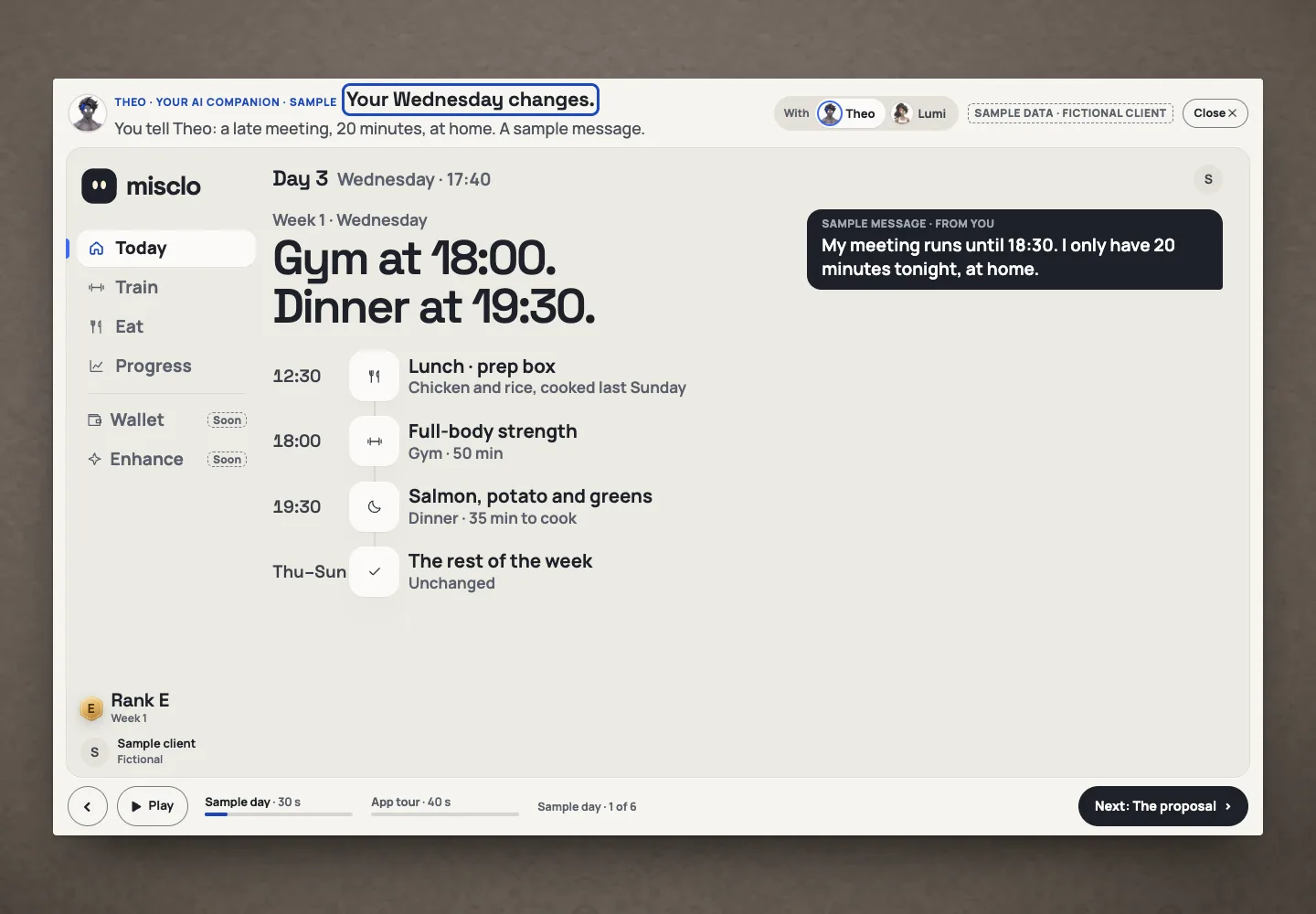
Misclo guided demo on staging: a sample Wednesday where a late meeting moves the plan to gym at 18:00 and dinner at 19:30.
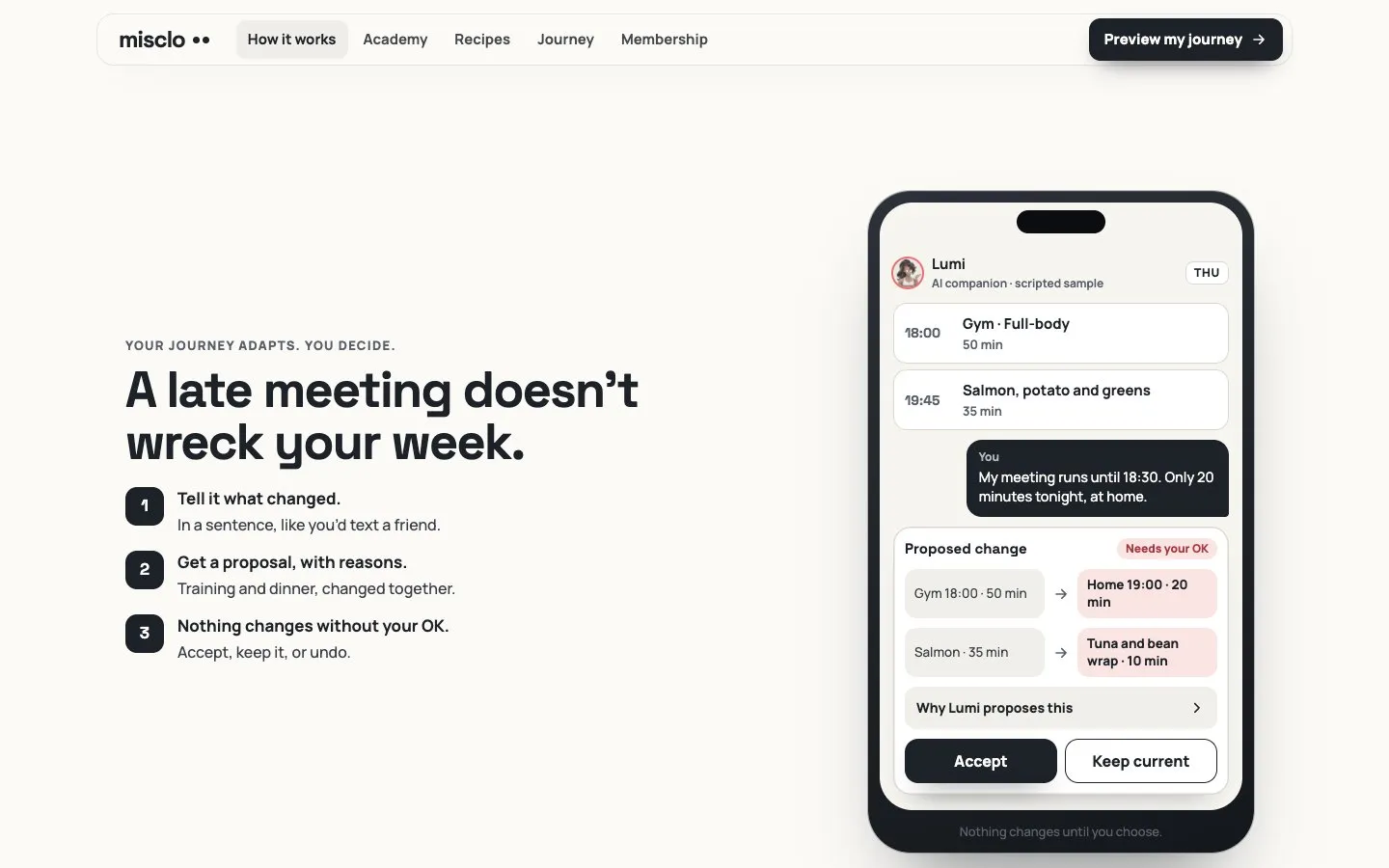
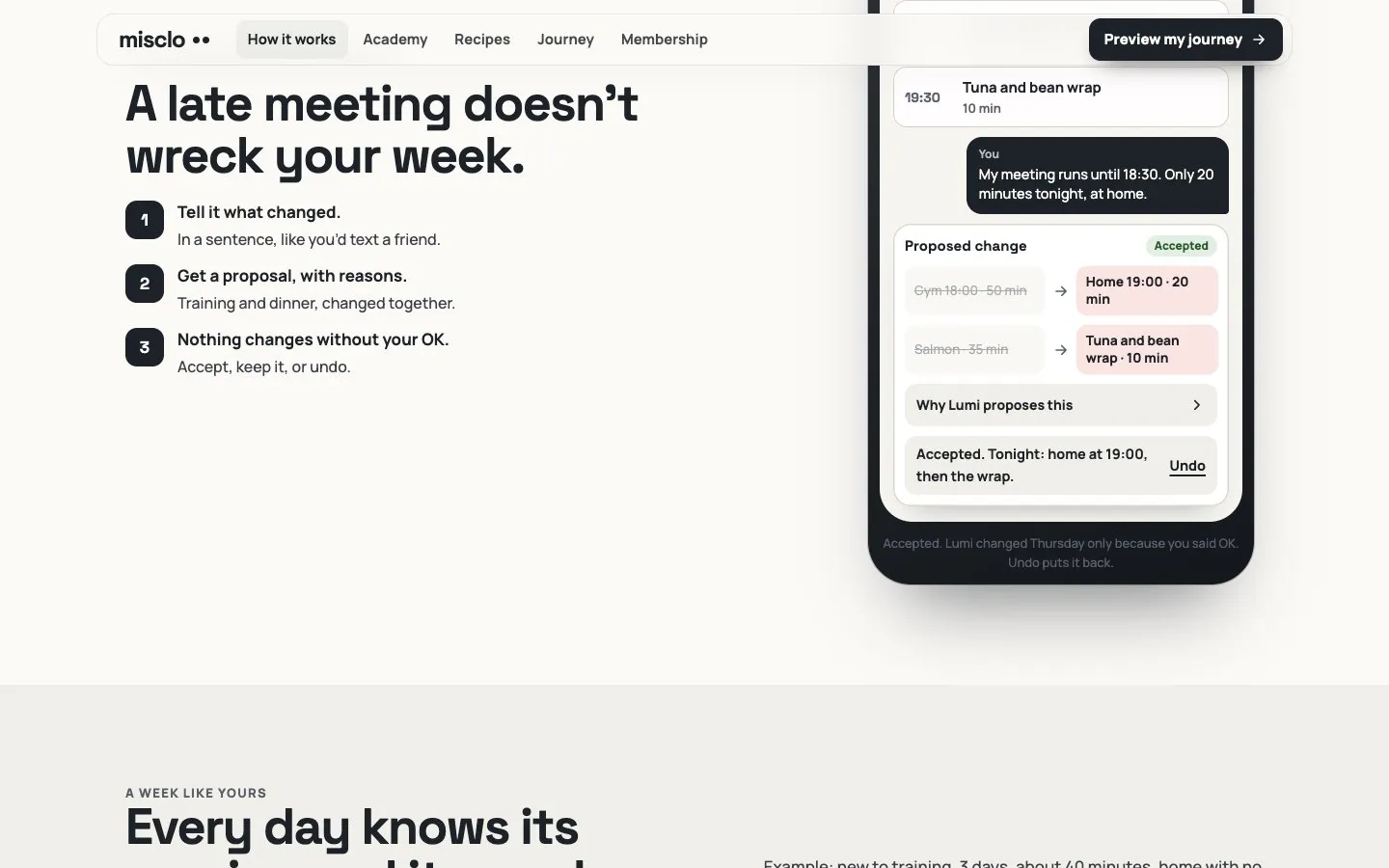
Misclo on a phone, on staging: a proposed change has been accepted and an Undo link is shown.
My own app · in developmentLaunch set · 1 Jan 2027
Misclo on staging: the guided demo and the phone view. Sample data, AI-generated character art.

The usual failure

The expensive surprises hide in who pays, who logs in and who sees what.

One pattern from my CTO years, anonymised: a membership platform built around family accounts. One parent pays, several family members each have their own linked profile, and each profile sees different things. On a feature list it looks like a detail. In practice it decides the data model, the checkout and every permission rule. Settled in week one, it’s a line in the spec. Discovered after the database is built, it means rebuilding the foundations.

That’s why my first step asks who pays, who logs in and who sees what, before a single screen exists. AI makes this more important, not less: one giant prompt gives you a demo that looks finished, with nothing underneath that a second developer could pick up.

Diagram: one parent pays. Several family members each have their own linked profile, and each profile sees different things.

It decides
The data model, the checkout and every permission rule.
Settled in week one
It’s a line in the spec.
Discovered after the database is built
It means rebuilding the foundations.
One pattern from my CTO years, anonymised.
  1. Building everything at once.

    Twenty features in version one, so none of them get tested with real people.

    I start with the one flow your users would pay for, and prove it first.

  2. The one-prompt build.

    It looks great on day three and falls over on day thirty: no data model, no permissions, no tests.

    I break the build into stages and disciplines, the way an agency staffs a project.

  3. Nobody owns the decisions.

    Changes arrive by voice note, nothing is written down, and the platform drifts.

    I keep a written spec and a dated decision log, and I quote your words exactly.

What I build

Five platform types. One way of building them.

Pick the one closest to your idea. Each card shows the core a first version usually needs, and the part of my background that’s most relevant to it.

Communities

For creators and associations who’ve outgrown a group chat.

Background As CTO I worked on membership systems, including one built around family accounts with linked member profiles.

01A first version usually needs

  • Member profiles
  • groups
  • feeds
  • events
  • paid tiers
  • moderation

02Asked before a single screen exists

  • Who pays
  • Who logs in
  • Who sees what

03Underneath, whatever the type

  • Data model
  • Roles and permissions
  • Hosted checkout, in test mode until you approve
  • Keys in the host’s secure settings, never in the code
  • Test scripts and a report
  • The previous version kept as the rollback

Something else? Most custom platforms are a mix of these five. Bring it to the call.

What you get first

You own the platform, the code and the reasons behind it.

A platform you can’t maintain without me is a liability. Everything I build is handed over so that any developer, or any AI, can carry on.

Here’s the shape of the first page of a Prototype Sprint spec. The project is fictional.

Fictional exampleprototype-spec.md
FICTIONAL EXAMPLE — "Studio Circle", a membership academy for pottery teachers
Problem (v1 only):teachers sell courses by DM and lose track of who paid.
Who:1 owner, up to 40 teachers, their students.
Core flow:student pays -> gets access -> watches lesson 1 -> books a live class.
Out of scope for v1:community feed, mobile app, certificates, affiliates.
"Working" means:5 real students complete the core flow without help.
Roles:owner (all), teacher (own courses), student (purchased courses only).
Payments:hosted checkout, test mode until the owner approves going live.
Secrets:stored in the host's environment settings, never in the code.
Decision log #1 (owner, verbatim):"Start with one course, not the catalogue."
Next gate:owner reviews the clickable flow before any database work.
Proof from the lab · in development

Misclo: my own AI fitness app, built by one person directing an AI team.

Misclo is my own product, set to launch on 1 January 2027 and in staging today. It’s the lab’s live test of the method I’d use on your platform. I make the product decisions and approve every step. Claude writes the interface, the code, the tools and the tests. ChatGPT with Higgsfield makes the film and images. A second AI coding assistant, Codex, works in parallel on a separate part of the code.

Every version lives in its own folder, with a written report and a test run. The previous version stays untouched as the rollback until I approve the next one.

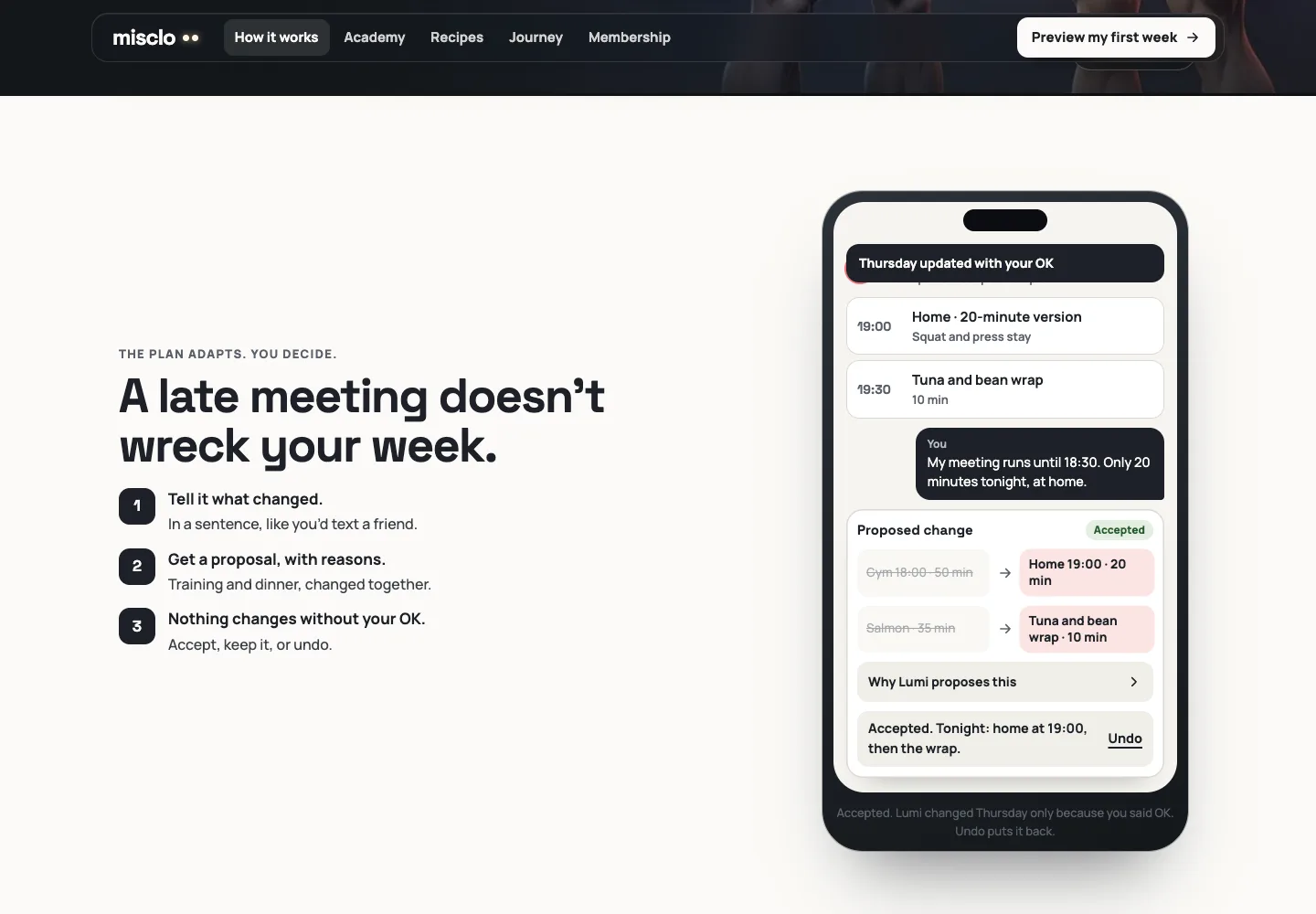
Proposed: Misclo phone screen: a late meeting leads the AI companion to propose a shorter home workout and a quicker dinner, waiting for the user’s OK. Accepted: The same Misclo screen after the change is accepted, with an Undo link.

Scripted sample · AI proposal → accepted · captured 9 Nov 2026, staging
  • A guided intake and plan. An 8-area intake with a health screen that sends any “yes” to a clinician first, 8 baseline tests, a 3/6/12-month timeline and a real month calendar.
  • An AI proposal you can refuse. When the plan adapts, the visitor sees the change and can accept all, pick, or undo. The product never decides silently. On staging this runs as a scripted sample.
  • A 3D body map in the browser. WebGL, 228 muscles and bones in 21 muscle groups, man and woman views, front, side and back. It loads lazily, falls back to 2D without WebGL, and has a keyboard muscle list. Anatomy model by Alex Lashko.
  • A reservation flow with honest failure states. Loading, invalid input, duplicate account, email verification and failure screens are all designed. No checkout is connected yet, and the page says so at the moment of action, so nothing fake is ever charged.
  • Checked by scripts. Automated layout suites on phone and desktop and an automated accessibility scan, run locally before I review each version.

Status: staging, not public, no users. This is proof of how I build, not proof of results. Character art and film are AI-generated under my direction.

Animated artwork of Aymane at his desk, smiling at the camera.My animated double (AI-generated)
Aymane Hitmi · Bali · solo with AI

Before AI was my team

I learned to ship platforms with a team of developers. That’s the standard I hold AI to.

For years, my job was the technical side of client platforms: audits, architecture, choosing the stack, running the build and keeping it alive after launch. As CTO, my team delivered and maintained 28+ client platforms: online academies, membership communities, e-commerce and nonprofit systems. AI changed who types the code. It didn’t change what a platform needs.

  • Client names are left out until each client agrees to be named. On the call I can walk you through the problems these platforms solved.
See the career work in the lab
  • 45+digital projects managed
  • 12developers in the team I led
  • 2software products I built and shipped

Built with AI, reviewed by me

AI writes most of the code. I own every decision it can’t make.

Working this way changes how fast I can try an idea, how cheaply I can throw a version away, and how much one person can carry. It doesn’t change the parts that make a platform trustworthy, so those stay with me.

AI does

  • First drafts of screens and code, test scripts, data migrations, documentation, and the boring checks a tired developer skips.

I do

  • The spec, the data model, who can see what, payments, security review, what ships and what waits.

You do

  • The decisions about your business and your users. You approve each stage before the next one starts.

Nobody does

  • Put API keys or passwords in the code, launch without a rollback, or claim a test passed when it didn’t.

How I work

Five stages. Twelve disciplines. One person accountable.

A good agency puts a strategist, a UX designer, developers, QA and a launch lead on a platform. I run the same disciplines with AI, in a fixed order, and I show you each stage before it replaces the last.

  1. Choose

    We agree on the one problem version one solves, who it’s for, who pays, who logs in, who sees what, and what “working” means.

    You get
    A one-page spec and a list of what’s deliberately left out.
  2. Set up

    Data model, roles and permissions, the stack, environments and the accounts you’ll own. The stack is chosen here, with the reasons written down: a configured open-source community and course stack when your idea fits one, custom code when it doesn’t.

    You get
    An architecture note in plain English, with an estimate of the monthly running costs, and access to everything from day one.
  3. Build

    One flow at a time: screens, logic, payments, the AI feature. Each change is shown to you first, with the previous version kept as the rollback.

  4. Automate

    Test scripts, accessibility checks, deploys, backups, and the admin jobs you’d otherwise do by hand.

    You get
    A report of what was checked and what failed.
  5. Improve

    Launch, watch how real people use it, fix and refine.

    You get
    A handoff file any developer, or any AI, can pick up from.

The disciplines

  • Strategy
  • Product and UX
  • Brand and visual
  • Copy and content
  • Frontend
  • Backend and data
  • 3D and motion (when needed)
  • AI features
  • Security and privacy
  • QA and accessibility
  • Launch and DevOps
  • Growth

Engagements and prices

Start small. Spend more only when the last step has proved itself.

Every platform I build goes through the same path. You can stop after any step and keep what has been built.

  • Platform / App

    Prototype Sprint

    From $1,200

    A working prototype of your core flow, ready to put in front of real users before you commit to a full build. You bring five people from your audience; I give you the test script and we review the sessions together.

    • The prototype
    • The spec
    • A written list of where your testers got stuck
  • Platform / App

    Focused MVP

    From $4,000

    The first real version: accounts, one core workflow end to end, payments, an admin dashboard and one AI feature, such as an assistant that answers from your own content. Deployed, tested, and yours.

  • Platform / App

    Full platform

    Quoted after scoping

    Typical range $7,000–$15,000

    Multiple roles (members, instructors, admins, clients), integrations with your CRM and tools, more AI features, and migration from what you use today. Quoted after the prototype: you get the exact figure in writing before work starts.

After launch

When the build is done you can take everything in-house, hire another developer, or keep me on. The handoff file is written so that any of the three works. Ongoing care is available as a monthly AI Operations Partner plan; scope and price confirmed on the call.

Not sure where you start?Personal AI Audit & Implementation Roadmap · $970Maps your business and tells you whether a platform is the right move at all.

Prices in USD, starting points for a defined scope. You get the scope, timeline and price in writing before anything starts. Running costs for hosting, database, email, payments and AI usage are separate and billed to you directly in your own accounts.

What you get

Everything is handed over so any developer, or any AI, can carry on.

  • Code
    The code

    In a repository under your account, with the history of every change.

  • Accounts
    The accounts

    For hosting, database, payments, email and the AI service, in your name and on your billing. I work as a guest.

  • Decisions
    The spec and decision log

    What we decided, when, and why, with your words kept exactly as you said them.

  • Tests
    The test scripts

    And the last report: what was checked, what passed, what didn’t.

  • Handoff
    A handoff file

    How to run it, how to deploy it, where the risks are, and what to do next.

FAQ

Straight answers.

Is a platform built with AI lower quality?

It can be, if the AI is left alone. Mine isn’t. Every change goes through a spec, my review, automated checks and your approval, with the previous version kept as the rollback. You can read the test report and the code at any point.

Who owns the code and the content?

You do. The repository, hosting, database and payment accounts are in your name from the start, and I work in them as a guest.

What happens if you’re unavailable?

That’s why everything is written down. The spec, the decision log and the handoff file let another developer, or another AI, carry on without me. That’s a habit from agency life, where projects had to survive people moving on.

Should I use Skool, Circle, Kajabi or Teachable instead?

Often, yes. If an existing tool covers most of what you need, it’s cheaper and faster, and I’ll tell you so on the call. There’s also a middle path: a configured open-source community and course stack that you own and host, with more room than a hosted tool and less to build than custom code. Fully custom makes sense when your method, your data or your business model doesn’t fit either box.

What do you build on?

We settle it in the first two steps: Step 1 answers who pays, who logs in and who sees what, and Step 2 picks the stack against those answers and writes the reasons into the architecture note. For communities and academies that fit a proven shape, I configure an open-source stack: WordPress with BuddyBoss for the community and LearnDash for courses, the stack I specialised in during my agency years. If your sales already run on GoHighLevel, the platform connects to it. When your model or data doesn’t fit that box, such as a SaaS workflow, logic shared across several organisations, or an AI feature at the core, I write custom code. Either way the code and accounts are yours.

What will it cost to run?

Third-party fees are paid by you, directly, in your own accounts: hosting, database, email, payments and the AI service. I estimate them in writing in the Step 2 architecture note, before the build starts. The AI feature gets a monthly usage cap and an alert, so a busy month can’t surprise you.

How long does it take?

It depends on the step and the scope. You get the timeline in writing with the scope and price, before anything starts.

Do you build native iOS and Android apps?

I build mobile web apps: they open from a link, can be installed on the home screen, and skip app-store review. If you truly need a native app, we’ll talk about it on the call.

What about my users’ data and payments?

Each user sees only what their role allows. Passwords and keys live in the host’s secure settings, never in the code. Payments go through a hosted checkout, and I test in test mode until you approve going live.

What AI features make sense in a platform?

Usually one, done well: an assistant that answers from your own course or help content, a smart onboarding step, or a feature that turns your users’ input into a draft plan they can accept or change. Before it ships, the assistant is tested against a written set of real questions, must cite the lesson it answered from, says when it doesn’t know, and has a monthly usage cap. I’ll push back on AI features that don’t earn their place.

Can I bring in my own developer or designer?

Yes. I’ll work from your designs or alongside your developer, and the handoff file is written for them.

I’m not ready to pay for a build. Where do I start?

Start with the free tools in my library, or join the free AI Business Build Week.

What happens on the 15-minute call?

You tell me what you want to build and for whom. I ask a few questions about your users, your budget and your timing. You leave with one of four answers: build it yourself (I’ll point you to the free tools), start with the $970 Audit, get a direct proposal, or it’s not a fit and I’ll say why.

Next step

Tell me what you want to build. In 15 minutes you’ll know the right first step.

Have it built

Book 15 minutes with me

Bring the idea, the spreadsheet or the half-built thing you’re stuck with. I’ll tell you honestly what the right first step is, even when it isn’t a build with me.

Free. No pitch deck needed. Possible outcomes: do it yourself, the $970 Audit, a direct proposal, or not a fit.

Prefer email? contact@labgenz.com